Blog
December 31st, 2009
End-of-the-year summaries have never been my strong suit, not least because I tend to measure time on completely different terms than the standard calendar (like counting up from the anniversary of an important event, for instance). And since nobody seems to be able to agree on whether the decade ends this year or next (anyway, doesn’t any ten-year span count as a decade?), I think I’ll leave that one alone as well.
Instead, I thought I’d share my own way of marking time—an experiment that I’ve been working on for two years now.
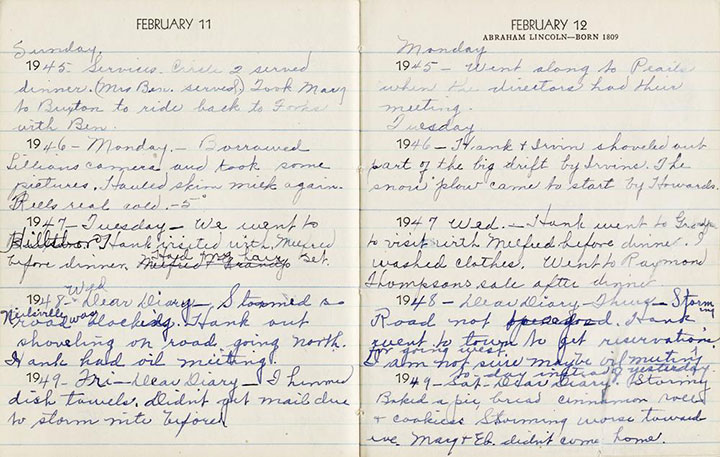
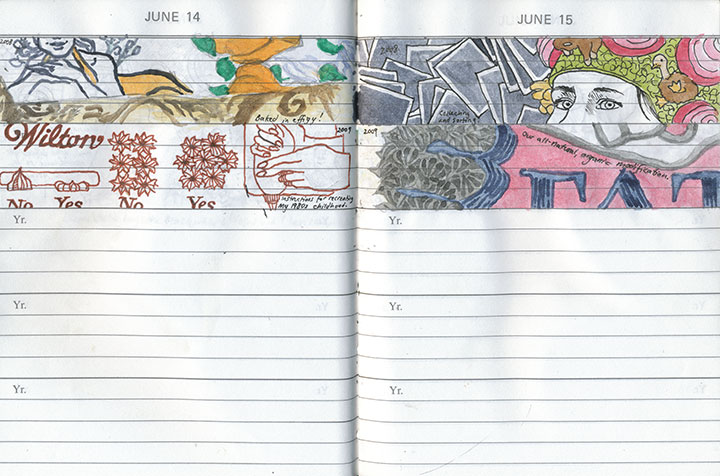
My friend Sarah Christianson has spent the last several years documenting the history of her fifth-generation family farm. Among her family artifacts are several of her great grandmother’s daily diaries, which Mrs. Anderson faithfully kept for many years. As you can see, there isn’t much space to write (so most entries say things like, “Went to the store, visited with Mildred,” etc.)—but what really interested me was how the five-year format of each page paints a larger picture of a woman’s life.
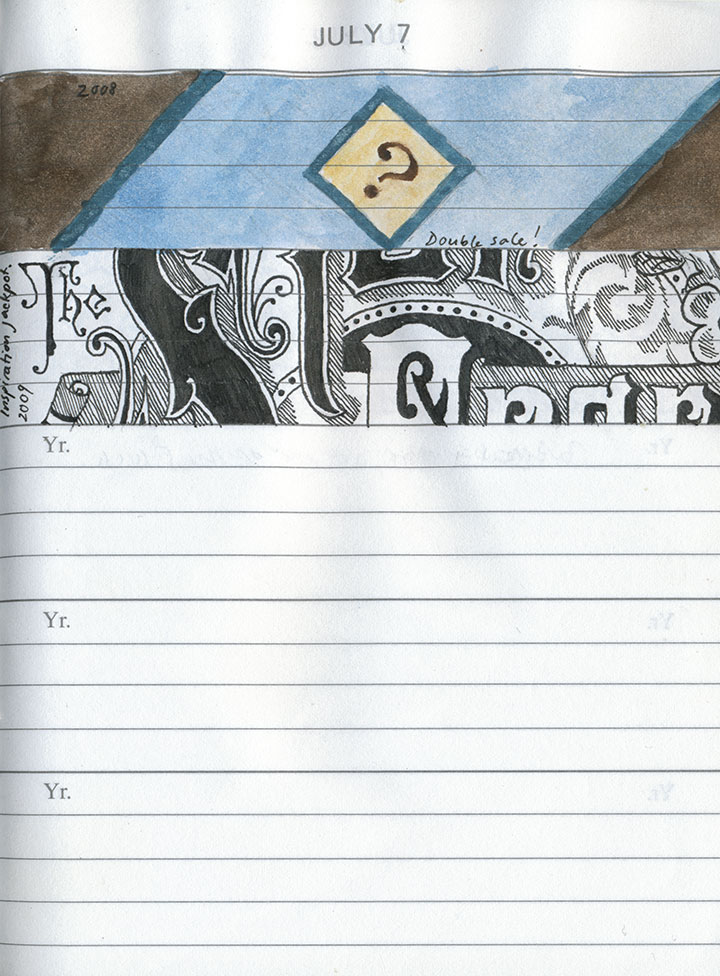
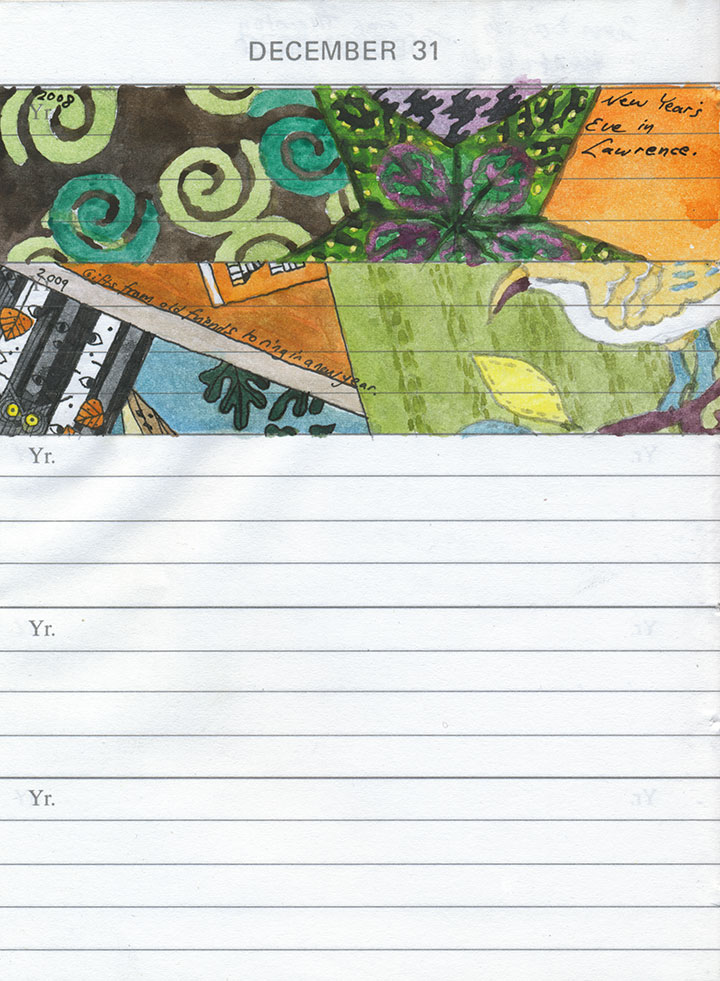
Sarah and I were both inspired to start five-year journals of our own, but I decided to turn mine into a sketchbook. I loved the idea and the challenge of documenting each day with a tiny, panoramic image.
Almost every drawing depicts something mundane, even trivial; it might be a sliver of that day’s activities, or just a snippet of an object that caught my eye. I’m almost never specific in the brief phrase written in each space—in fact, already I find myself forgetting what I was referring to when I go back to look at past entries. When I do remember what I was talking about, though, each illustration triggers my memories better and more richly than any of my photographs or writing can.
But that’s not the point of this project; this was never meant to be a detailed journal of my every thought or action. Instead, I’m trying to remind myself to really look at the world around me, and to live in my own present.
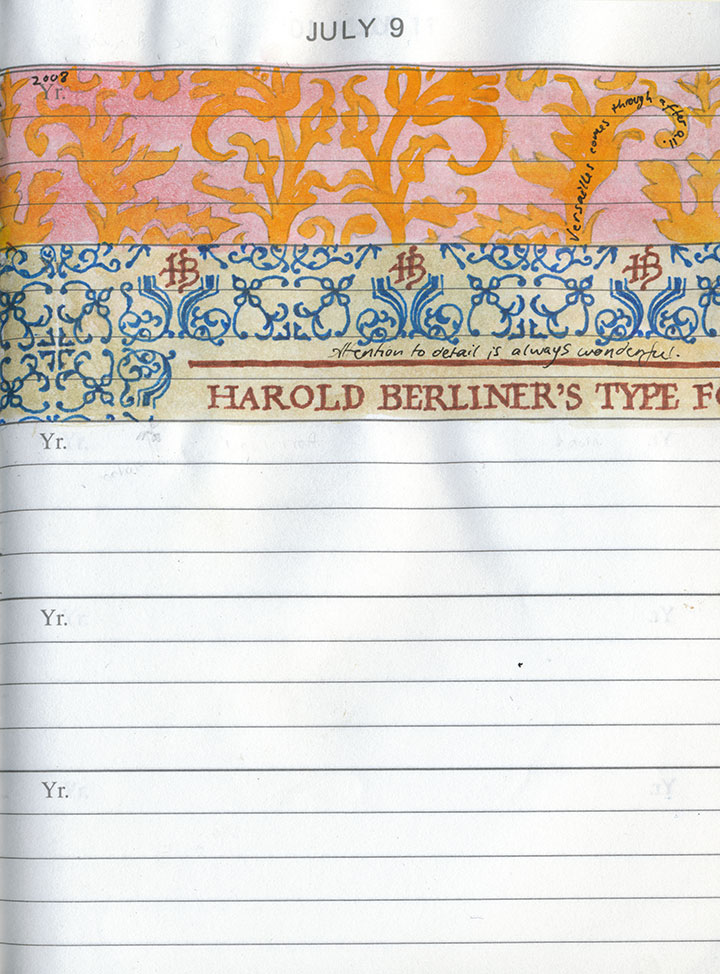
Now, exactly two years into the project, the same type of narrative I found in Claire Anderson’s diaries is already beginning to emerge. The drawings serve as a sort of flip-book; as one pages through the journal my personality, tastes and interests come to life, and the result is a more complete picture of myself than I ever could have come up with consciously. And an interesting by-product of all of this is the sometimes-unwitting documentation of the current era—this book might prove to be useful in other ways, someday.
The really curious bit is how the book is both intensely personal and completely ordinary. There isn’t a single image in there that I couldn’t share with a total stranger (no nudity, no embarrassing missives, no dirty laundry, etc.), and yet I’ve only actually shown it to a handful of people. I’m not sure why that is, but now that I’ve gone “public” about it I’m sure I’ll post occasional excerpts from here on out.
At the very least, maybe this will tighten the screws on my discipline a bit. Sarah and I learned quickly how difficult it is to keep a daily journal like this, whether in words or pictures (I doff my hat to Mrs. Anderson’s habits)—it’s all I can do to keep up with it, and I’m often playing catch-up. But now that I see how worthwhile the effort has been, I find myself excited for whatever tomorrow brings.
And isn’t that the whole point?
Wishing you a happy New Year full of wonderful events and tiny moments worth savoring—however you choose to remember them.
December 25th, 2009
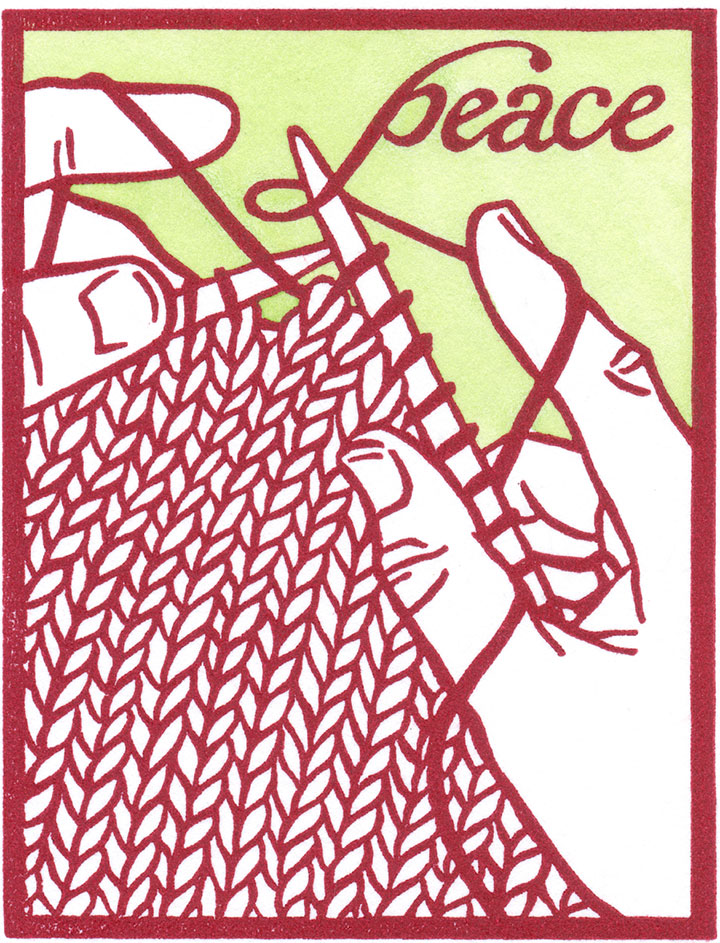
Every year I whip up a little holiday postcard and send it winging to far-flung friends and family. It’s a long-standing tradition of mine, and an important constant when many other holiday plans change from year to year. This year’s card reflects my own personal plans for Christmas this year—I fully intend to spend some serious quality time with needles and wool.

We’re staying home and having our own Christmas this year, and along with rare treats like time for knitting and the luxury of jigsaw puzzles, the celebrations come complete with seasonal goodies (like these saucy sugar cookies made by my friend Maggie)…
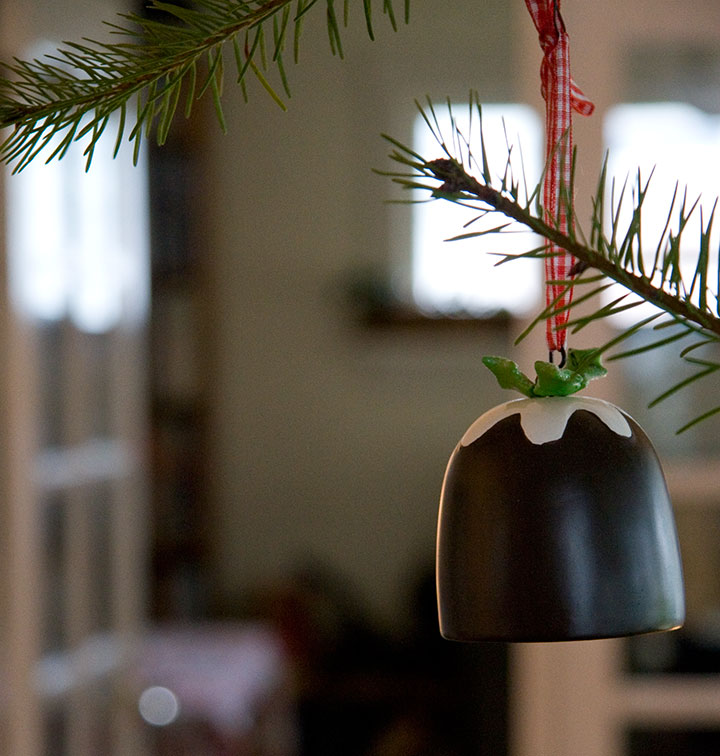
…cozy surroundings…
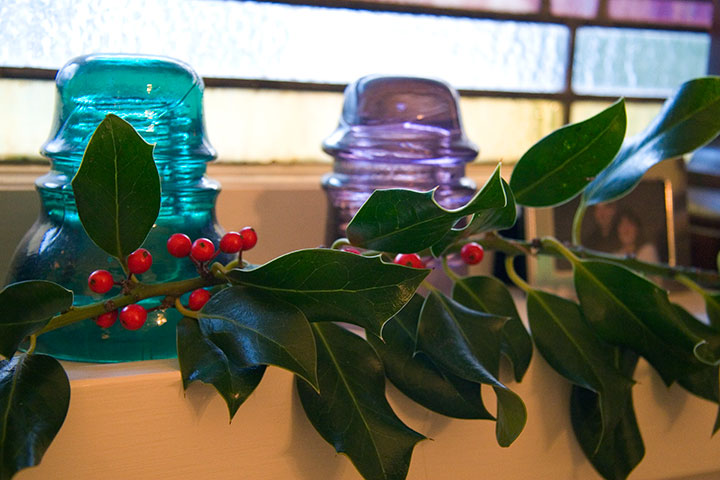
…and all the comforts of home. So this is my Christmas card to you. Wishing you the merriest of holidays, and a new year filled with peace, love, and joy.
December 22nd, 2009
If you’ve been reading this blog for awhile, or you’ve met me or the Tailor, you already know about our penchant for storing food and taking seasonal eating to hardcore extremes. But our nuttiness about walking the talk extends far beyond the pantry. Another aspect of our attempts to live as sustainably as we can is our rejection of synthetic materials. Now, we’ll never live entirely free from petroleum products—we drive a car. We own a refrigerator, a stereo and a plethora of records, tapes, CDs and DVDs. I use a computer, a scanner, a digital camera, and a host of accompanying accessories. I’m not about to buy underwear with a button waist. I gleefully print with photopolymer plates. And we just can’t let go of our small, sentimental collection of deliciously hideous, ancient Tupperware. But all things considered, you’d be hard-pressed to find much plastic in our house. Whenever possible we buy clothing, tools, containers, furniture, and everything else made purely from natural materials: wood, metal, glass, cotton, linen, wool, silk, bamboo, cork, bone, shell. Much of the time, nowadays, that means we have to look for vintage versions of whatever we’re shopping for, but you’d be surprised at what’s available—as long as one is willing to search for it. I know how extreme this position is—and believe me, it’s not something that can be done overnight. This is a process years in the making, and just the fact that we’re still working at it (and probably always will) shows that it’s not for everyone, and certainly not the only solution out there. But the biggest benefit of it all is how long-lasting our belongings are—and when things break, they can usually be mended, rather than thrown away and replaced.
The biggest downside, however, is that by choosing this path we also choose to abstain from some creature comforts and cultural elements that are dated from after the advent of plastic. Most of the time I don’t miss it—or even notice anything lacking. But right now, during the holiday season, I have a fierce craving for twinkle lights that I just have to resist (if anyone can find me twinkle lights made entirely of glass bulbs, metal wire and cloth cord, I’ll be all over it).
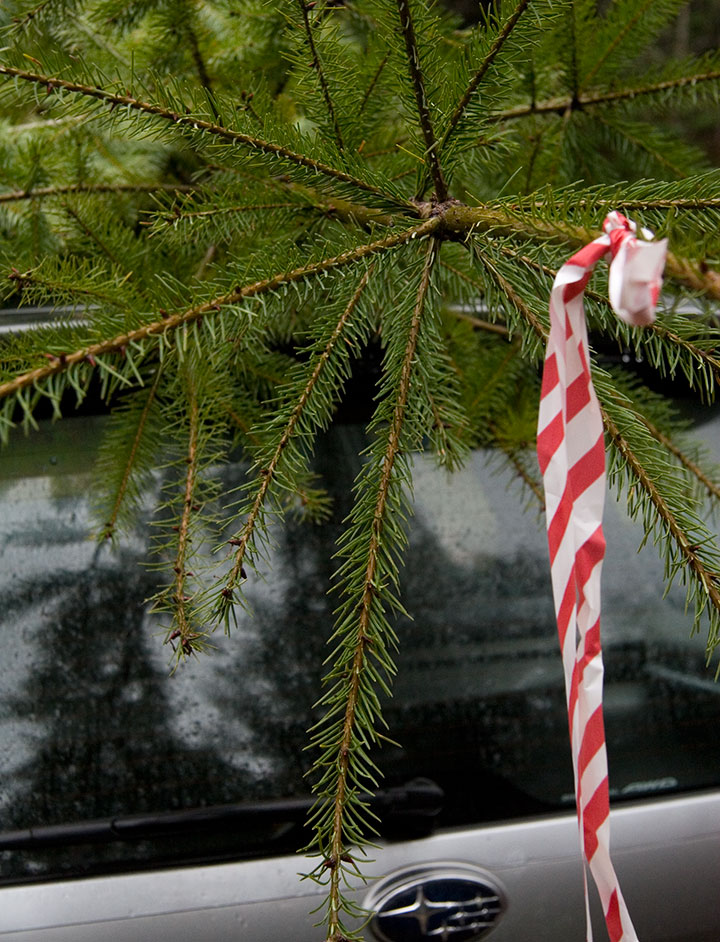
Even with our solemn vows to thwart plastic, our search for a Christmas tree left us in some doubt (I grew up with an artificial tree, and have only had one Christmas tree of my own—a real one, three years ago). Is it better to buy a fake tree once or intentionally kill fifty-odd living evergreens in one’s lifetime? Which is worse—fossil fuels or deforestation? How about burning fossil fuels on our way to deforest a section of land?! (The irony of the freshly-killed tree tied to a hippie Subaru in the above photo isn’t lost on me.) And can one family really do so much damage just by celebrating the holidays, or should we just stop worrying so much?
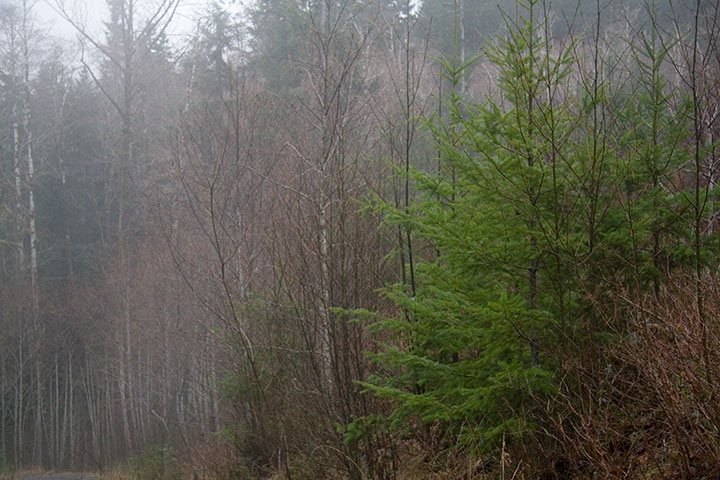
In the end, we followed the same instincts we rely on for our choice to remain omnivores: we decided on a real tree (after all, we do live in a place with abundant trees that shoot up fast, thanks to our rainy climate), as long as it could be culled responsibly. So we called up some friends who own land near Olympia, and as luck would have it, there were some young Douglas-firs on their property that were scheduled to be removed in the spring.
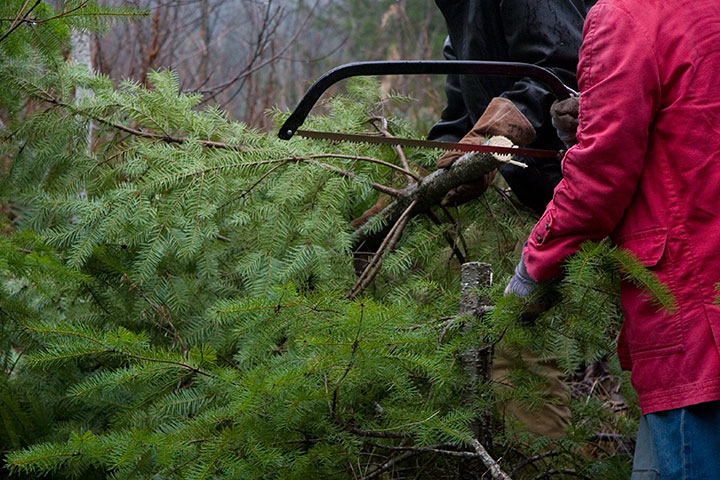
A little elbow grease later, we had our Christmas tree.
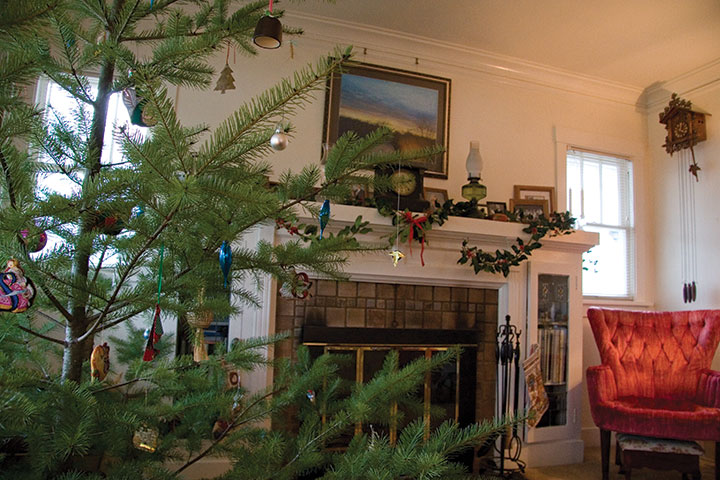
It doesn’t have the textbook perfection of a farmed tree, but it looks lovely in the living room, bedecked in handmade and vintage ornaments (I think there are exactly four plastic items contained therein). And as we decorated it on the solstice, I privately gave thanks to the land for contributing to our holiday.
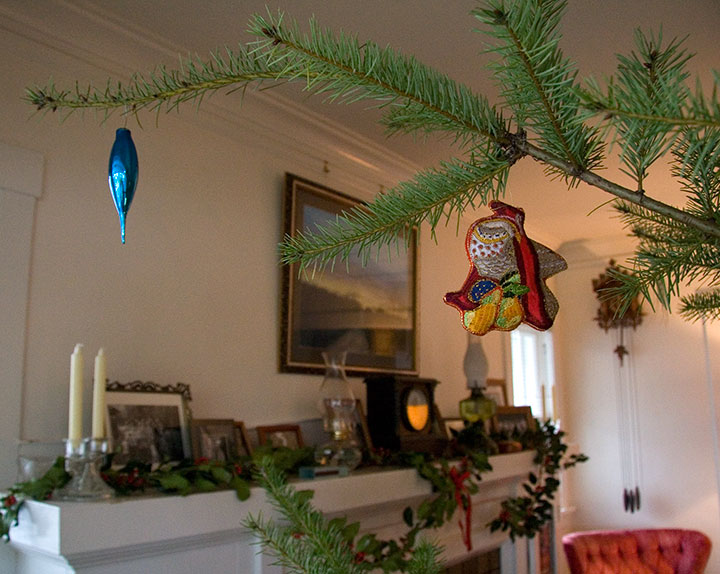
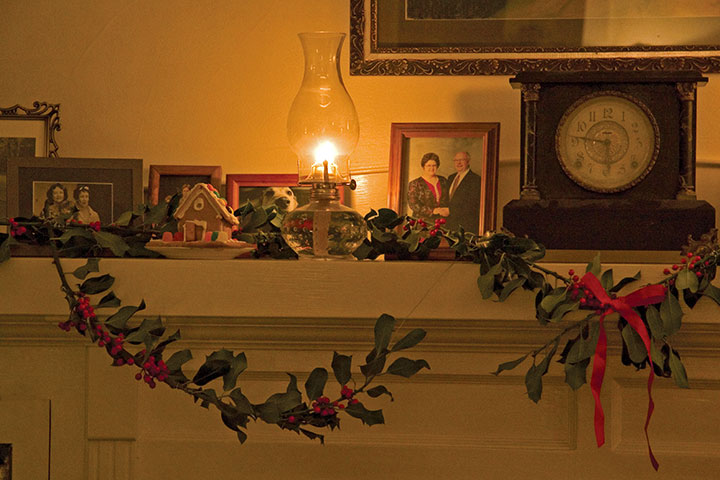
Now that we live in a house with a fireplace, we can finally hang the stockings by the chimney with care. And with a fireplace comes a mantel just begging to be decorated.
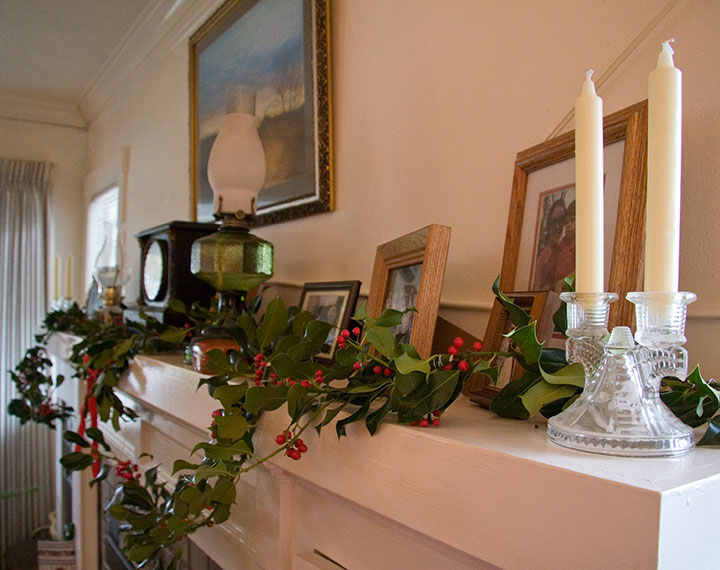
So another friend invited us to clip some holly branches (holly is a beautiful but noxious weed around here, so pruning is always welcome) from his back yard, and with the help of a little steel wire I whipped up a Christmas garland.
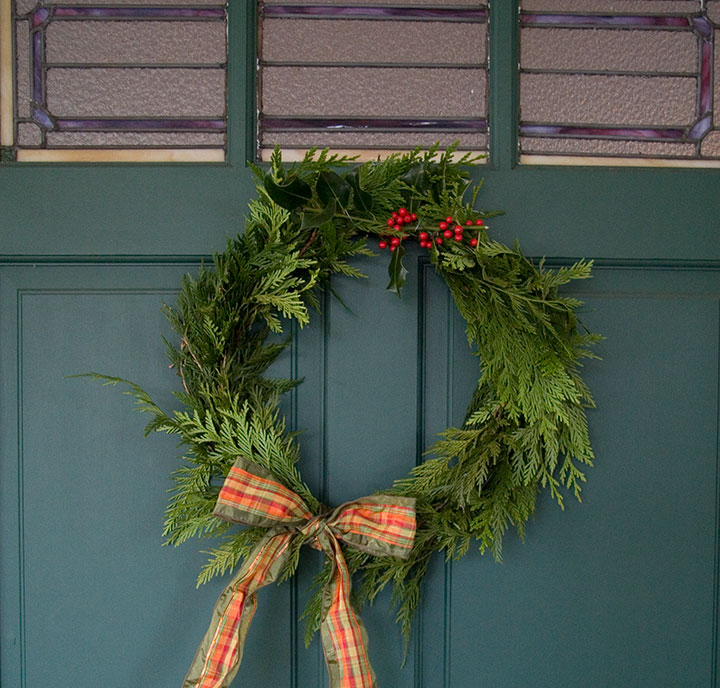
We used a bit of leftover holly and some cedar prunings for a wreath, and suddenly it was Christmas at our house. So maybe I don’t have my beloved twinkle lights, but somehow it feels better this way. We had a big holiday potluck last night, with thirty or so people crammed into our living and dining rooms, bellowing carol harmonies and exploding crackers and cheering when the Tailor poured blue-flaming brandy on the plum pudding. And nearly every one of them said it felt like their grandmother’s house, or their childhood traditions, or what they imagined of Christmases past. So maybe I don’t so much need that string of lights.
Still, since the moment we decided on a real tree I’ve been reminded of my favorite Robert Frost poem—which might make me all the more conscious of our choice, but also more appreciative of the holiday in general. After all, a Christmas tree is something the city “could not do without and keep its Christmas.”
Christmas Trees
(A Christmas Circular Letter)
The city had withdrawn into itself
And left at last the country to the country;
When between whirls of snow not come to lie
And whirls of foliage not yet laid, there drove
A stranger to our yard, who looked the city,
Yet did in country fashion in that there
He sat and waited till he drew us out
A-buttoning coats to ask him who he was.
He proved to be the city come again
To look for something it had left behind
And could not do without and keep its Christmas.
He asked if I would sell my Christmas trees;
My woods—the young fir balsams like a place
Where houses all are churches and have spires.
I hadn’t thought of them as Christmas Trees.
I doubt if I was tempted for a moment
To sell them off their feet to go in cars
And leave the slope behind the house all bare,
Where the sun shines now no warmer than the moon.
I’d hate to have them know it if I was.
Yet more I’d hate to hold my trees except
As others hold theirs or refuse for them,
Beyond the time of profitable growth,
The trial by market everything must come to.
I dallied so much with the thought of selling.
Then whether from mistaken courtesy
And fear of seeming short of speech, or whether
From hope of hearing good of what was mine,
I said, “There aren’t enough to be worth while.”
“I could soon tell how many they would cut,
You let me look them over.”
“You could look.
But don’t expect I’m going to let you have them.”
Pasture they spring in, some in clumps too close
That lop each other of boughs, but not a few
Quite solitary and having equal boughs
All round and round. The latter he nodded “Yes” to,
Or paused to say beneath some lovelier one,
With a buyer’s moderation, “That would do.”
I thought so too, but wasn’t there to say so.
We climbed the pasture on the south, crossed over,
And came down on the north.
He said, “A thousand.”
“A thousand Christmas trees!—at what apiece?”
He felt some need of softening that to me:
“A thousand trees would come to thirty dollars.”
Then I was certain I had never meant
To let him have them. Never show surprise!
But thirty dollars seemed so small beside
The extent of pasture I should strip, three cents
(For that was all they figured out apiece),
Three cents so small beside the dollar friends
I should be writing to within the hour
Would pay in cities for good trees like those,
Regular vestry-trees whole Sunday Schools
Could hang enough on to pick off enough.
A thousand Christmas trees I didn’t know I had!
Worth three cents more to give away than sell,
As may be shown by a simple calculation.
Too bad I couldn’t lay one in a letter.
I can’t help wishing I could send you one,
In wishing you herewith a Merry Christmas.
December 10th, 2009
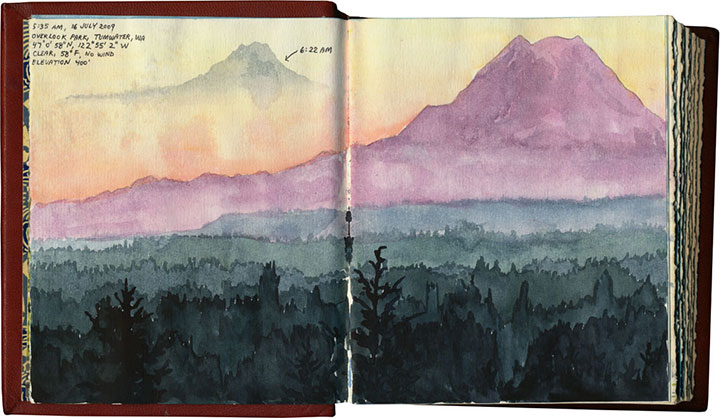
After nearly a year, image-gathering for my Mt. Rainier artist book is finally coming to an end, and I’m starting to make the final illustrations. I have a huge stack of sketches, scribbles and recorded data, and thousands upon thousands of photos to sift through. This month and next are scheduled for the all-important (and terrifying) process of Figuring Out How the Heck to Make It Work—physical mock-ups, final compositions, text-writing, etc. But before I could move on with a clear conscience, I had one last far-away location to cross off my research list: Portland. And for some reason, the stars just weren’t aligning for me.
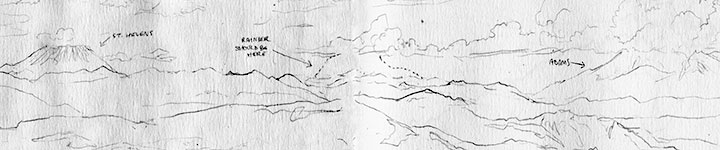
My first attempt this summer was also my first-ever trip to the city, so I had to location-scout with a blank mental map—and when I finally found what I was looking for, it was too hazy to see anything anyway (hence the dotted line where Rainier should be). Since Portland is 140 miles away, I couldn’t just try again any old time I pleased. As the months went by, I became increasingly frustrated—the location I visited over the summer (Larch Mountain) is inaccessible in the winter, and although I had another spot in mind, my schedule and the weather (which was way harder to pin down than an open travel day!) just couldn’t find anything in common; the last few months have been typically Northwestern, with plenty of rain, fog and drear for a volcano to hide behind. Finally, last week, it seemed I had my chance. T-town was socked in with pea-soup fog, but since the previous day had started the same way and ended in sunshine, I decided to go for it. As I cleared the Puget lowlands and the fog lifted, I caught crystal-clear glimpses of Rainier to the east as I went, and my confidence rose. I wouldn’t know for sure until I got there, but the sunny weather seemed like it would hold. I made good time to Portland, wound my way up to Council Crest Park, jogged up to the viewpoint and faced north—
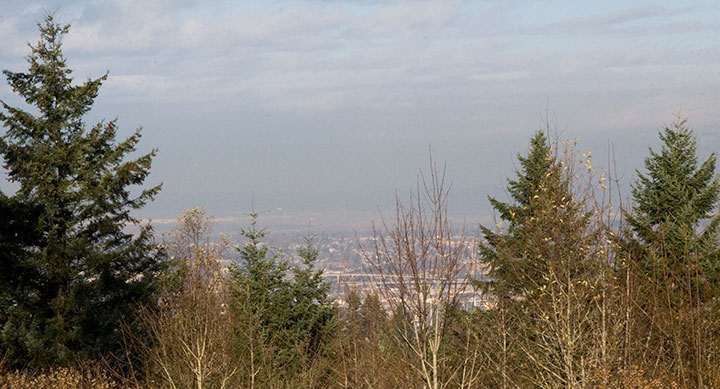
—and saw that Mt. Saint Helens didn’t get the memo. It had its own private weather system blocking Rainier from view.
It was a long drive home that night.
The last few days were torture. The weekend taunted me with sunny mornings and cloudy afternoons (good thing I didn’t take the bait), and the perfect weather went untested Monday and Tuesday while I taught class and kept appointments instead. By Tuesday night, I was sure I’d missed my last chance, and resigned myself to leaving Portland out of the book. But yesterday dawned cold and flawlessly clear, and I was astonished to find my calendar empty. I left the Tailor an incoherent voicemail at work (“I’m going right now! I’ll be back tonight!”) and jumped in the car. Exactly two hours and twenty-three minutes later, this is what I saw:
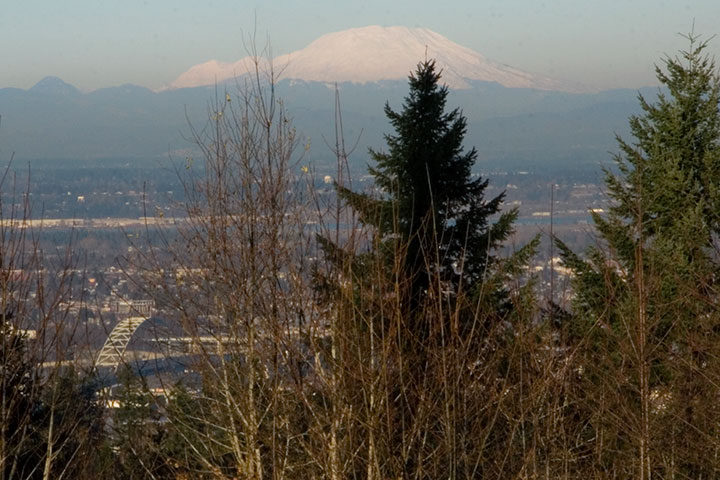
That’s St. Helens in front, with Rainier just peeking around her left shoulder.
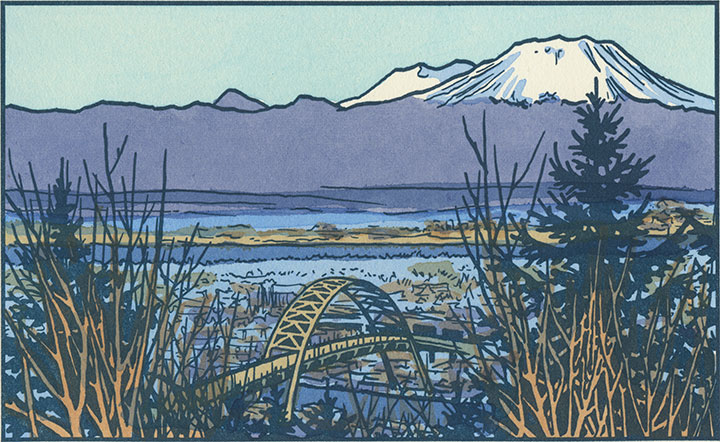
And here’s the illustration that resulted from all this work:
And in case I had any doubts about one image being worth all this trouble, Portland offered me a little bonus—a compositional jewel that I could never have dreamed up on my own:
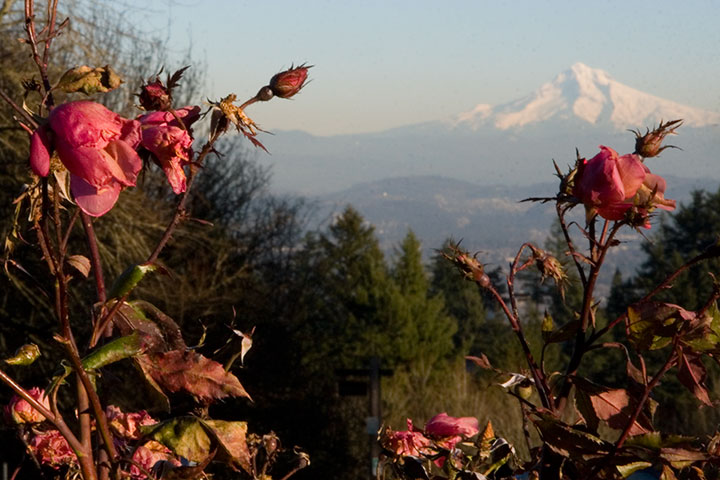
The City of Roses was still, impossibly, in bloom.
December 6th, 2009
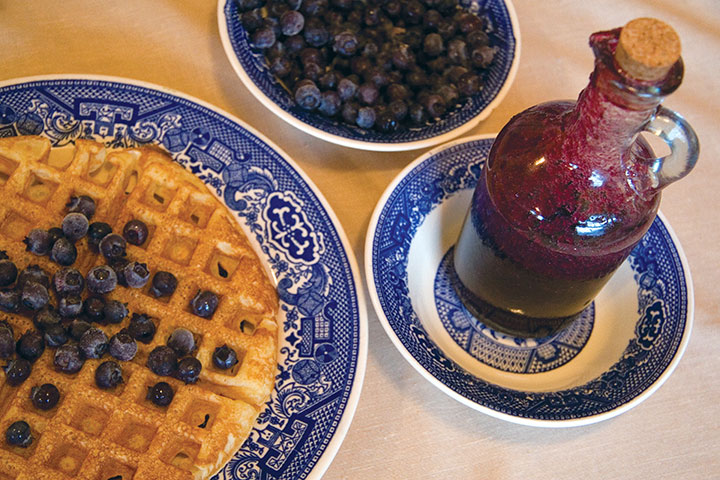
For months now we’ve been finding new ways to use our stores of dried, home-canned and preserved blueberries. But we almost forgot about the containers of fresh berries we threw in the freezer—and on this unseasonably cold* morning, whipping up a little reminder of summer seemed like a good idea.
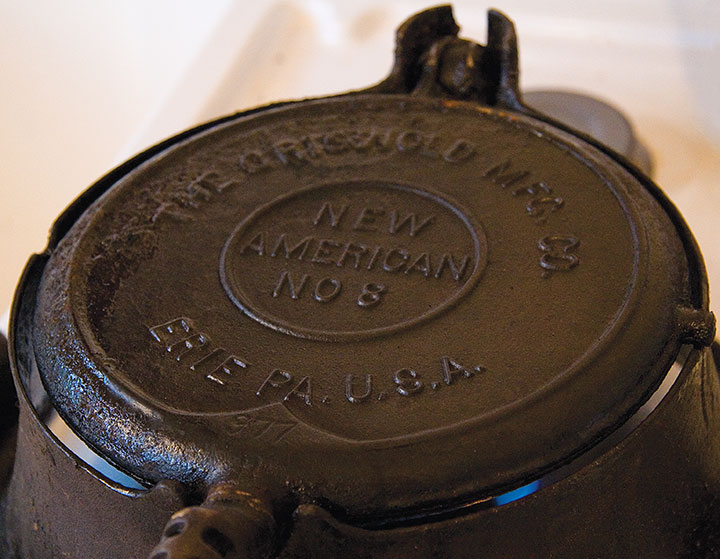
So the Tailor fired up the Cast-Iron Stovetop High-Collared No. 8 Griswold Waffle Iron™ (say that five times fast!), and we had ourselves a good old-fashioned hot breakfast—which, incidentally, goes great with the homemade blueberry syrup above, but the Tailor won’t share that recipe, I’m afraid.
No-Kiddin’ Waffles
2 ¼ cup flour
4 tsp. baking powder
¾ tsp. salt
1 ½ Tbsp. sugar
2 eggs, beaten
2 ¼ cup whole milk
½ cup oil (we use Canola)
Sift the flour, baking powder and salt three times, then add the sugar. In a separate bowl, mix the beaten eggs, milk and oil. Add this to the dry ingredients and mix thoroughly. While some people like to make their batter ahead of time, we’re firm believers in using fresh-fresh-fresh batter. So for best results, make your waffles right then and there.
Oil your cast-iron waffle iron well before starting. Heat both sides of the iron thoroughly (the advantage of a high-collared iron like this is even heating and plenty of room to flip waffles), and remember to apply oil after every third or fourth waffle—a bristle brush is handy for this.
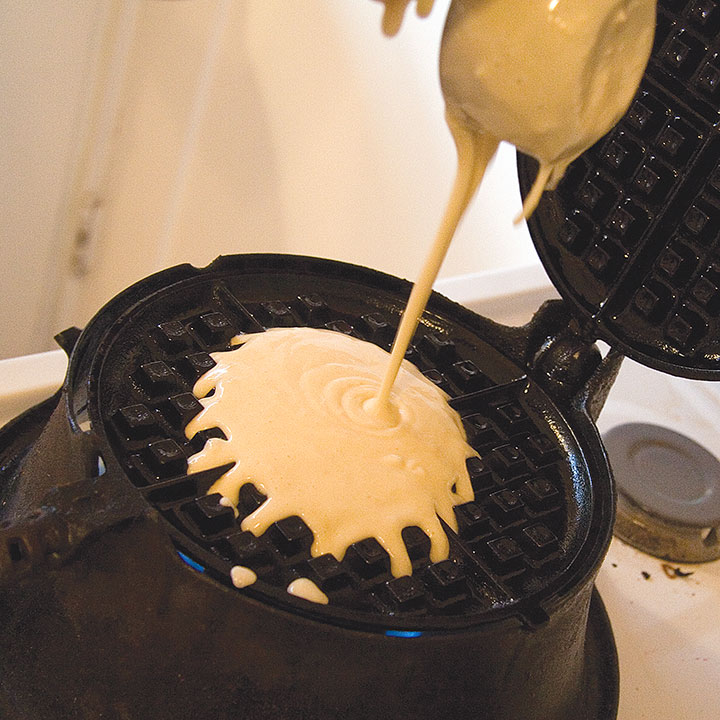
Use a 1/2 cup measure to dip batter—one dip per waffle—and pour the batter into the center of the iron. When you close the lid, the batter will wick evenly into all the nooks and crannies.
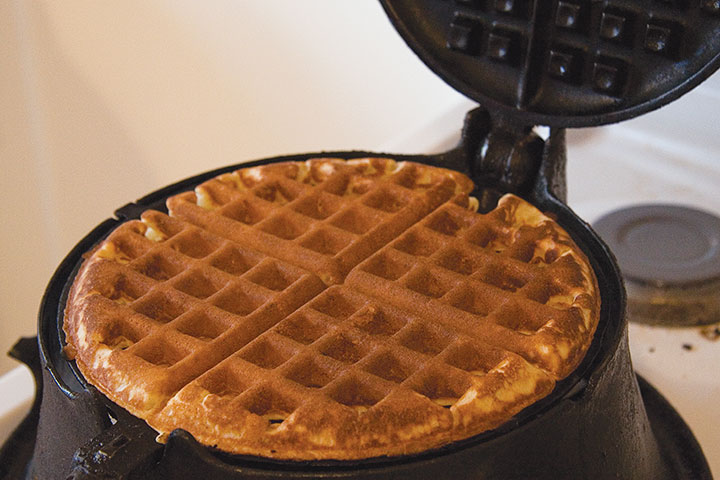
Cook the waffle for 3-4 minutes (peek occasionally to make sure your iron isn’t too hot!), flipping frequently—every thirty seconds or so. The best part (other than the flipping, that is)? Waffles are kind of like pizza—you can jazz them up however you like with your favorite breakfast condiments. But eat ’em fast—a jazzed-up waffle will get cold and soggy** before too long.
That’s never a worry around here, though—these babies get gobbled up long before the next waffle is ready!
• •••••••• ••••••••• ••••••••• ••••••••• ••••••••• ••••••••• •••••••••
* I know all you Minnesotans are rolling your eyes at this declaration, but a nighttime temperature of 17°F is enough to force us to rescue our squash colony from the attic, which isn’t insulated for “real” winter. So until the attic temperature stays above freezing, our pumpkins and butternuts are living in the spare bedroom like edible houseguests—definitely one of the less glamorous aspects of living seasonally.
** I’m really into the specific heat of foods. Mashed potatoes? High specific heat. Fresh waffles? Sadly low.
December 2nd, 2009
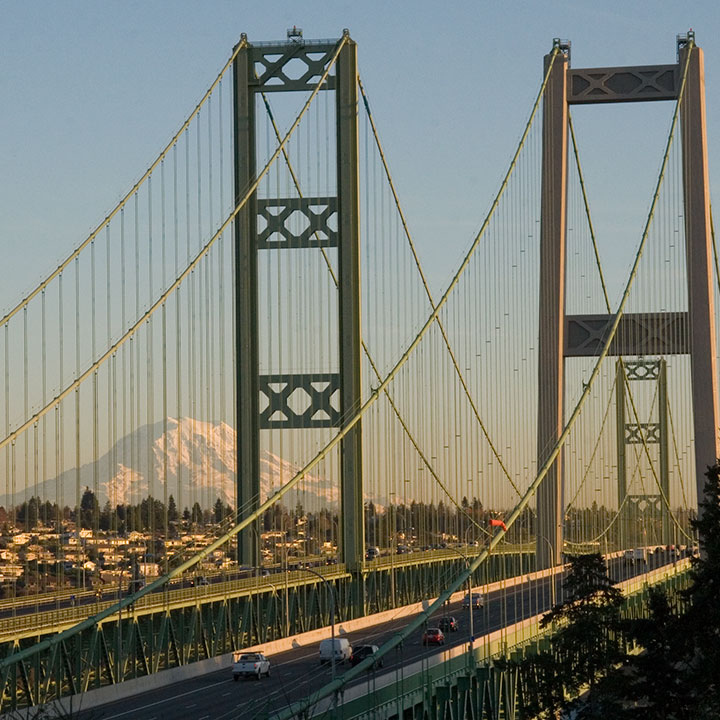
Reason number 6,792 why I love it here.
![Chandler O'Leary [logo]](https://chandleroleary.com/wp-content/themes/chandleroleary/images/logo.png)