Blog
October 27th, 2009
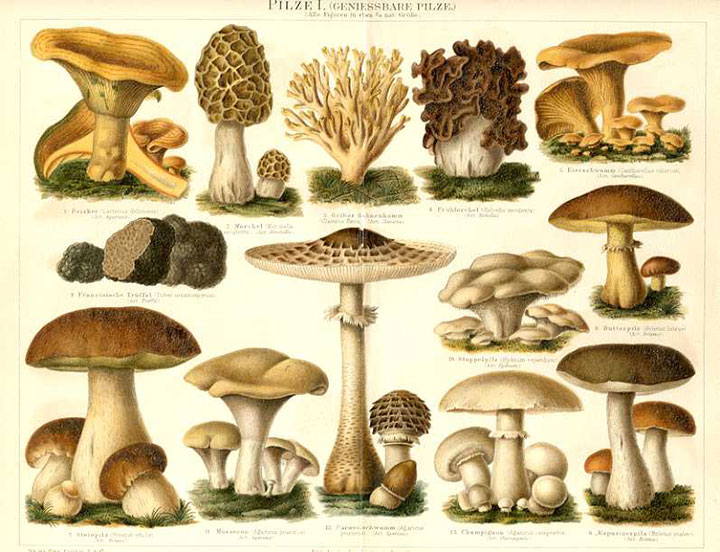
Now that we live in a vacation destination, we tend to get a lot of out-of-town visitors. We have a list of favorite places to take first-timers, so we can often be found at places like the Pike Place Market, Point Defiance, and Mt. Rainier with house guests in tow. When a pair of French foodies arrive on your doorstep, however, it’s a whole ‘nother ballgame. Our friends Gilles and Jean-Philippe had just one major request for their visit last weekend: mushroom hunting. Since it’s chanterelle season and the weather was good, Saturday seemed like a good day to lace up our hiking boots and grab our pocket knives.
Disclaimer! The Tailor and I are not experienced mushroom gatherers, so we’d never try this on our own—incorrectly identifying edible fungi is not a mistake one wants to make. Even the most detailed books can’t replace the presence of a skilled guide, so if you don’t have your own French mycophile on hand to take you hunting, skip the risk and buy a bag of chanterelles at the farmers market!
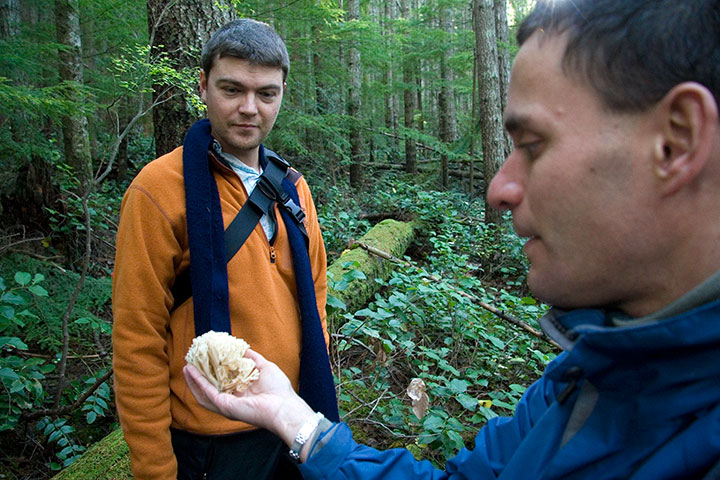
As far as dinner ingredients go, we came away empty-handed—the conditions just weren’t right. But as a crash course in the sheer diversity of local fungi, it was a spectacular day; we found several dozen different varieties ranging from beautiful to bizarre; delicate to disgusting.
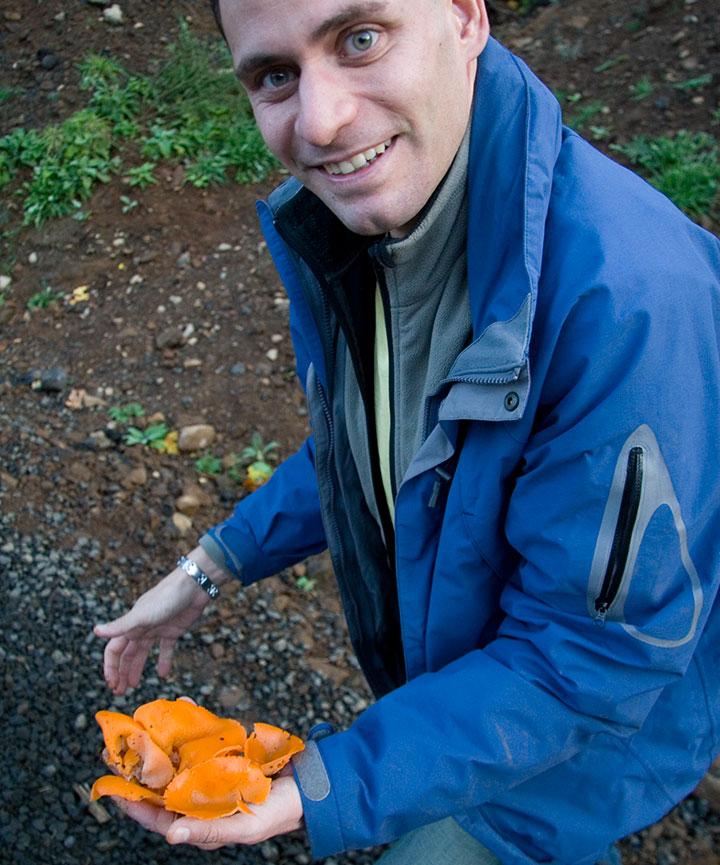
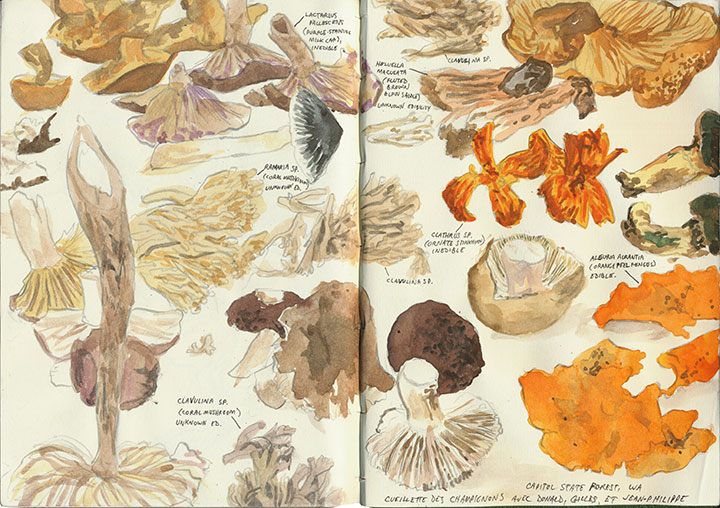
We did find a few edible species (these orange peel cups were a beautiful and exciting highlight), but nothing worth turning into a meal. So the day turned out to be more of a scientific field trip—certainly a worthwhile adventure in its own right.
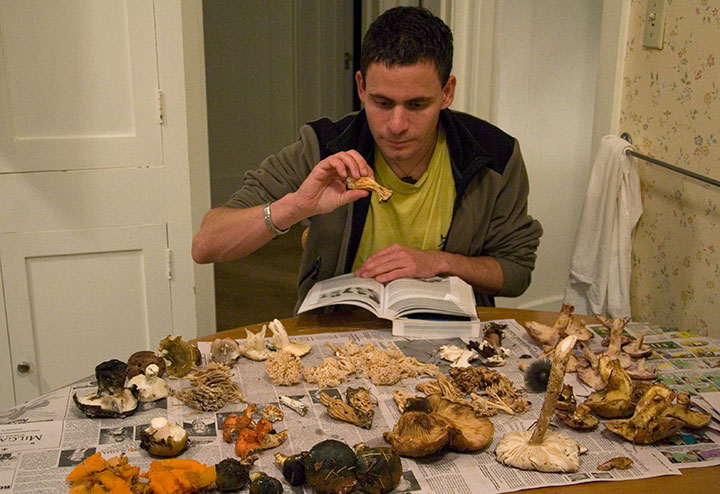
When we got home, Gilles spread out our haul and set to work identifying, making us laugh whenever he called out something strange (stinkhorn, elfin saddle, hedgehog—called sheep’s foot or pied-de-mouton in France).
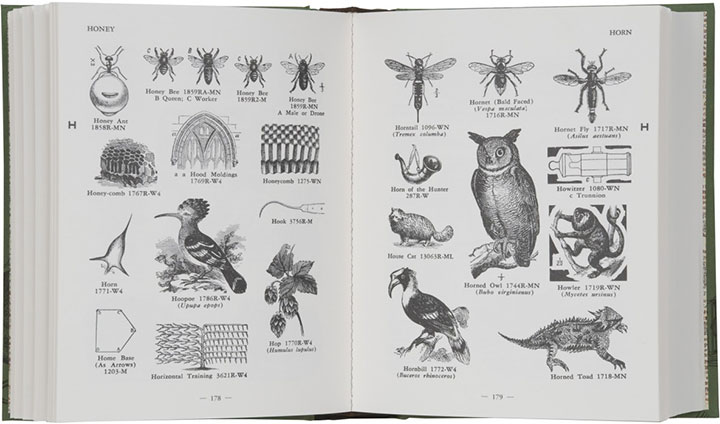
As for me, all this mushroom-naming reminded me of the newest addition to my reference library: the stunning Pictorial Webster’s, by book artist John Carrera (for a mind-blowing art experience, check out the video on the process behind the book here). So I took a page out of his book (sorry, I couldn’t resist), and did a little visual taxonomy of my own.
Jean-Philippe, meanwhile, had the best idea yet: purchasing a pound or two of fresh chanterelles, and putting his mad French cooking skills to work. The sumptuous champignons dish he whipped up disappeared into our mouths long before I thought to grab the camera, but I did remember to ask for the recipe:
Chanterelles à l’improvisation
– 1 1/2 pounds fresh chanterelle mushrooms, halved
– 1/2 cup bacon (3 slices or so)
– 1 medium yellow onion, chopped
– 4 to 5 Tbsp olive oil
– 1/4 cup dry white wine (the Muscadet we had on hand was great)
– dry parsley to taste (fresh is better, but we didn’t have any)
– salt and pepper to taste
Brown the bacon until crisp, then break into small pieces. In a separate, large pan (so as not to overpower the mushrooms with the flavor of bacon fat), sautée the onions in olive oil over medium-low heat until lightly browned. Add the chanterelles, bacon, salt, pepper, and white wine, and sautée until the mushrooms are slightly limp and drained of most of their water content (oh, say 5 or 6 minutes). Season with parsley at the very end, then serve either alone or over brown rice. Watch the dinner conversation devolve into a series of satisfied grunts.
October 22nd, 2009
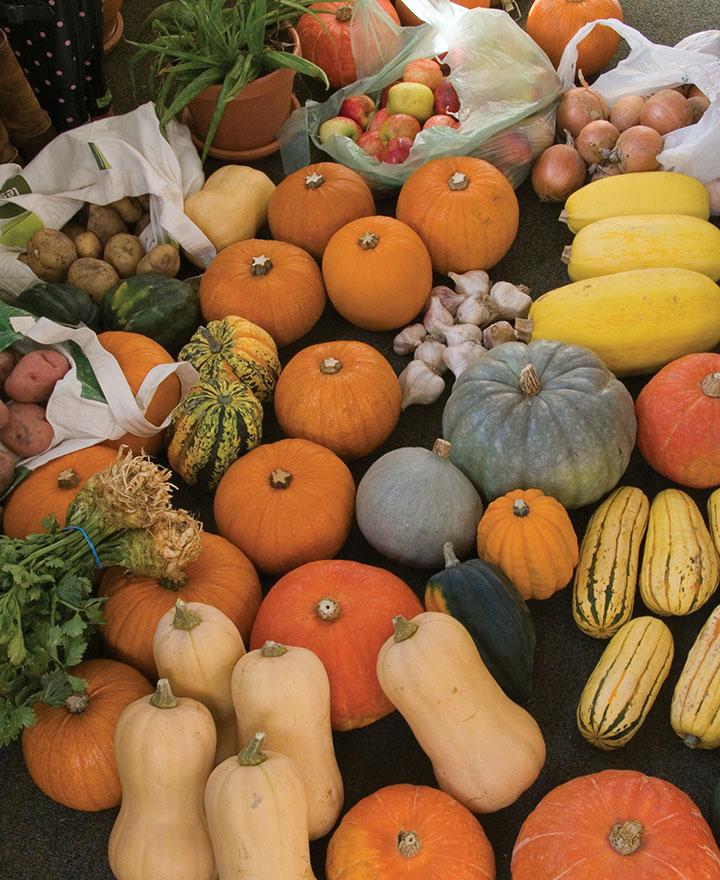
If you had seen our back porch last weekend, you’d probably think we were starting our own farmers market. But this is a typical sight for many seasonal foodies like us; when you swear off strawberries in January, you need enough fresh autumn fruits and veggies to last you until the end of April (notwithstanding my usual February freak-out where I cave in to a craving or two for salad).
We still have quite a ways to go yet, but we’re working hard to fill our root cellar, attic, freezer and pantry shelves with a wide variety of staples and goodies to keep our winter diet interesting. Here’s what we’ve got so far:
In the root cellar:
– 20 lbs. onions
– 10 lbs. apples (still need 2 bushels)
– 10 lbs. potatoes (still need at least 80 lbs., plus a bushel of carrots and parsnips)
– 9 bottles of wine
In the freezer:
– 4 lbs. locally cured, nitrate-free bacon
– 5 whole, local “Rosie” chickens
– various cuts of local, organic meat
– various cuts of venison, provided by my father-in-law
In the refrigerator:
– 5 lbs. fresh cranberries (for canning; more to come)
– 2 or 3 red cabbages
– 6 or so honeycrisp apples (which don’t keep long but are my favorite kind)
– 1 bunch celeriac root now in my belly—yum!
– 1 lb. garlic
In the pantry:
– 25 lbs. rolled oats
– 5 lbs. steel-cut oats
– 10 lbs. coarse-ground grits (not local, obviously, but the mill is definitely a mom n’ pop operation)
– at least 6 different kinds of rice
– 30 lbs. sugar (mostly for canning)
– 3 quarts local, single-source honey
– 15 or so different varieties of loose-leaf tea
The Tailor’s 2009 home preserving yield to date:
– 5.5 quarts dried blueberries
– 6 pints blueberry syrup
– 5 pints canned whole blueberries
– 9 pints blueberry jam
– 9.5 pints blackberry jam
– 8.5 pints raspberry jam
– 6 pints strawberry jam
– 15 pints canned heirloom tomatoes
– 16 pints tomato sauce
– still to come: apple butter, apple sauce, cranberry sauce, chicken broth
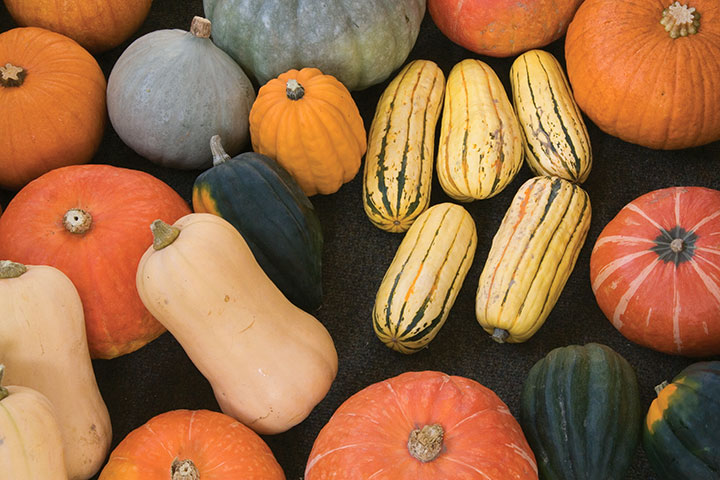
And then there’s the winter squash in the attic: one of my favorite parts of the season, and of living and eating in the Pacific Northwest.
In the attic:
– 14 sugar pie pumpkins
– 8 kabocha squash
– 7 delicata squash
– 6 carnival squash
– 7 acorn squash
– 6 butternut squash
– 3 spaghetti squash
– 1 mini hubbard squash
– 1 jarrahdale pumpkin
Okay, we might have gone a little overboard on the squash, but I never get tired of it, and it’s an important staple of a seasonal diet. We keep these babies in the attic because they last much longer there—pumpkins and squash prefer a cool, dry environment to the cool humidity of the cellar. Our squash colony is a big conversation piece, and we get a lot of questions about pumpkin storage, so I’ll share the scoop:
First, choose squash and pumpkins with intact stems—those that have had their stems snapped off won’t last long. Next, make sure your squash was harvested before the first hard freeze; post-freeze specimens rot fast. Check around the stem and on the bottom end for any mold, rot, blemishes, damage, or sogginess. Now it’s time to sock them away—an attic is best, but anywhere that’s cool, dry and dark will work fine (but never let them freeze! During a cold snap last year we had to haul them all down into the living room when the attic hit 32 degrees!). Don’t stack your squash; just like apples, a rotten squash can infect any neighbors it touches. Instead, we make little “nests” for them by crumpling up newspaper and cushioning each one individually, in a single layer. As long as they’re unblemished and in good shape, and stored carefully, many varieties will last until at least March. Spaghetti squash will often keep until April, but sadly, butternut (my absolute favorite) tends to have the shortest lifespan. So eat those first, and relish every bite.
I feel like a little pumpkin pie. How about you?
October 17th, 2009
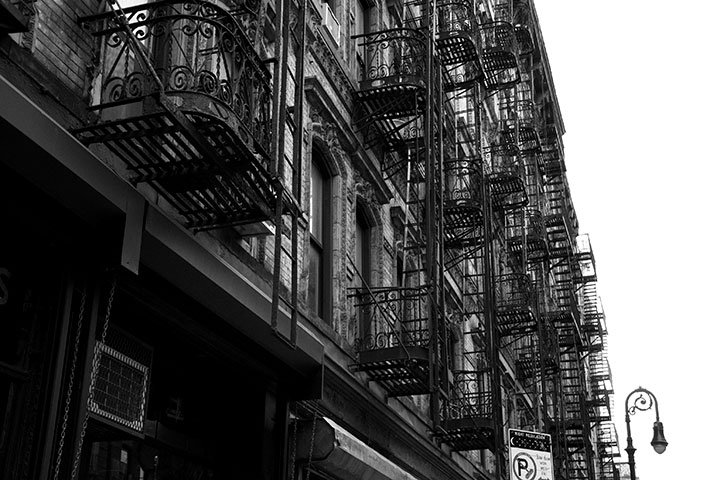
Last week I spent a few days in New York for the wedding of some dear friends.


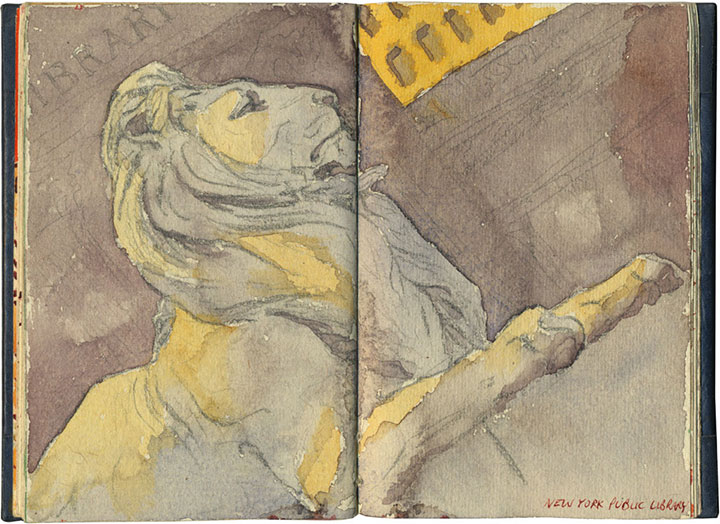

I lost track long ago of just how many trips I’ve made there over the years, or how many months’ residence would equal the sum of all my days spent there (plenty).

My memories and souvenirs reflect this. I have whole sketchbooks devoted solely to Manhattan; boxes of still-good Metrocards and train schedules; miles of film negatives and a mental Rolodex stored to the brim with makeshift maps, habitual errand circuits and addresses of favorite haunts.
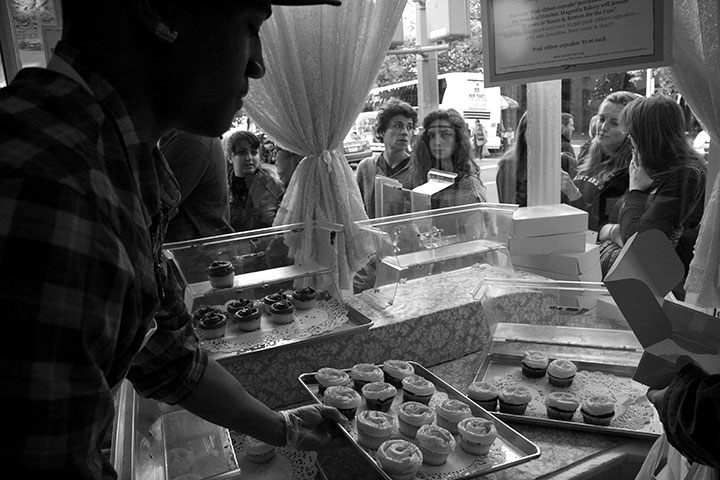
Every time I visit, it’s hard to string together a cohesive narrative of the adventure afterward.

Instead, my memories of New York are always a series of brief impressions; moments caught like fireflies in a jar.

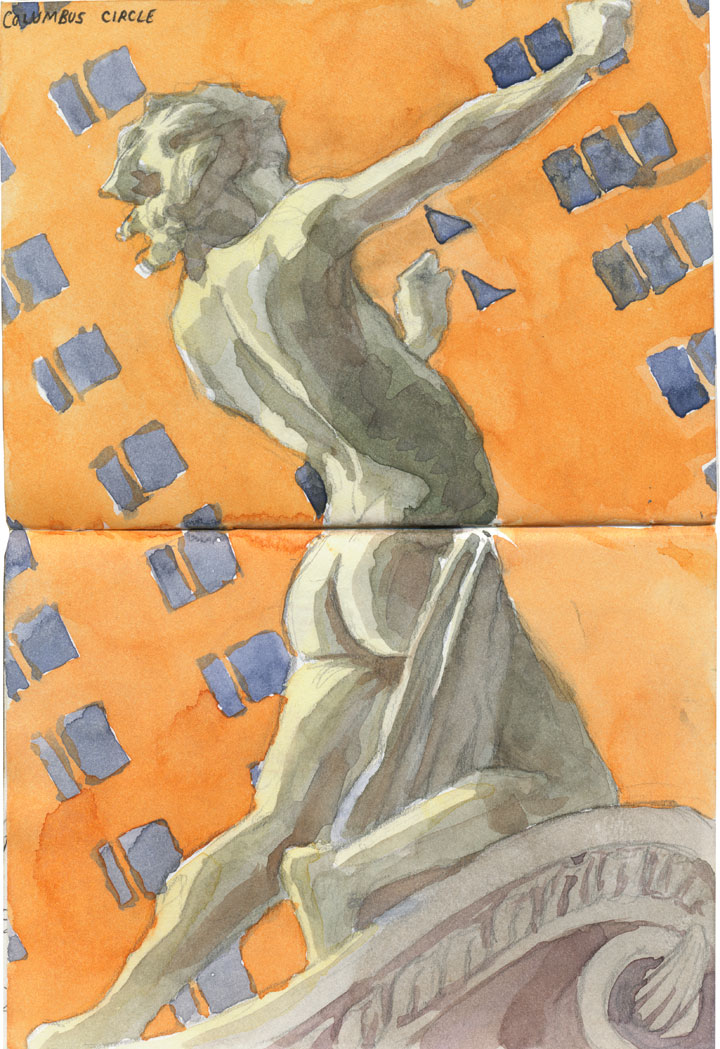
Maybe it’s because each day finds me all over the map of the city, alternately in teeming crowds and completely alone;

or because I’d rather remember the best events and forget the worst (I’ve got a whole long list of those, too);
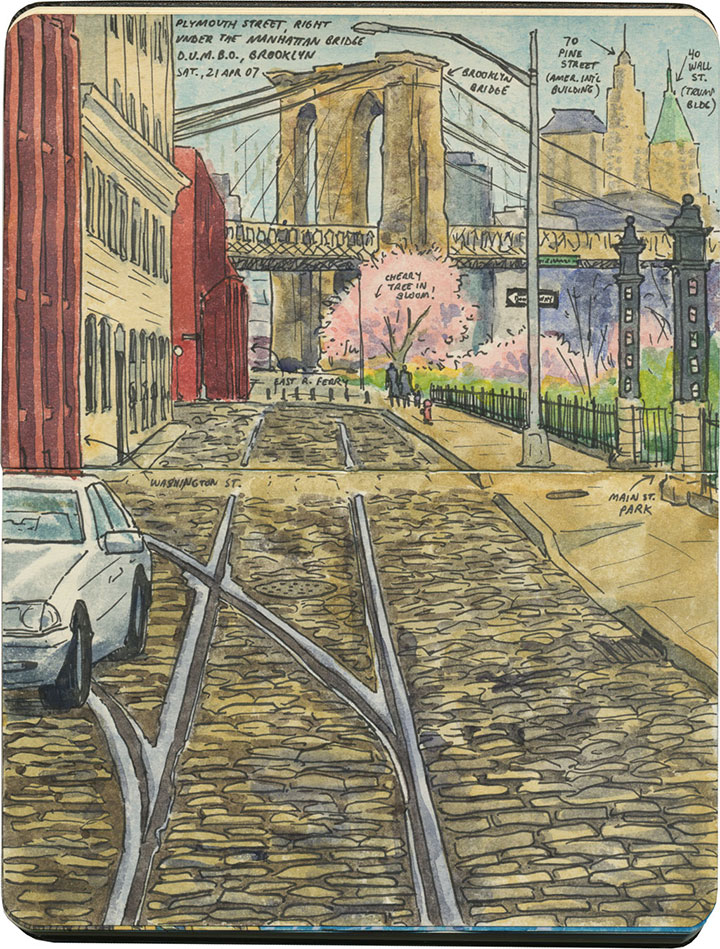
or maybe I owe it to the very nature of drawing and photography—whatever the reason, this trip was no different.


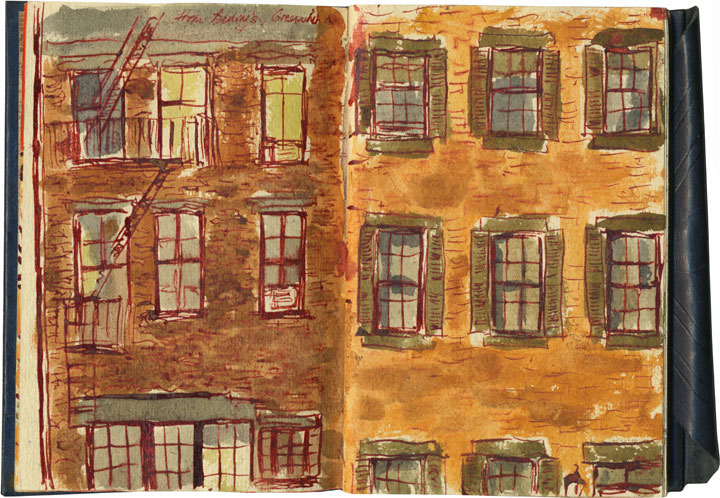
And every moment is another thread woven into a huge, neverending tapestry that tells the story of my very own, personal New York.

And for me, that’s the best thing about it.
October 14th, 2009
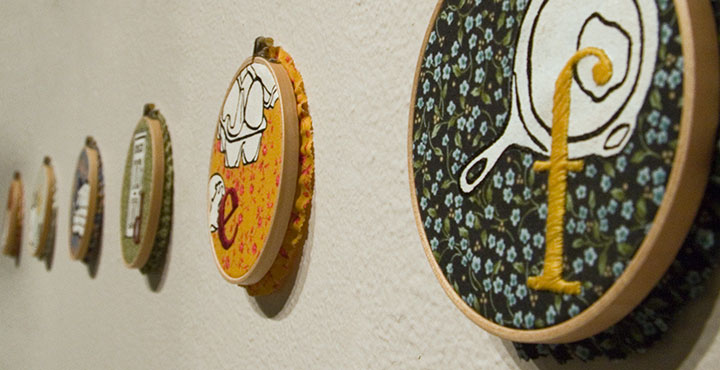
When I walked into the PLU Gallery this morning to document the Mnemonic Sampler show when it opens, my brain had somewhat of a short circuit. Since I was out of town for the past few days, all of the installation work was done for me (thank you a million times over, Heather C.!)—so this was the first time I’d laid eyes on the work since framing it up and chucking the pieces in a box. I somehow couldn’t connect the finished work on the walls with the crazy, chaotic process of the past few months. It seemed so simple, like this was somebody else’s show, and all the nail-biting and never-ending futzing I’d been doing was for some other project that would remain unfinished forever. But I did finish it—and there it is!
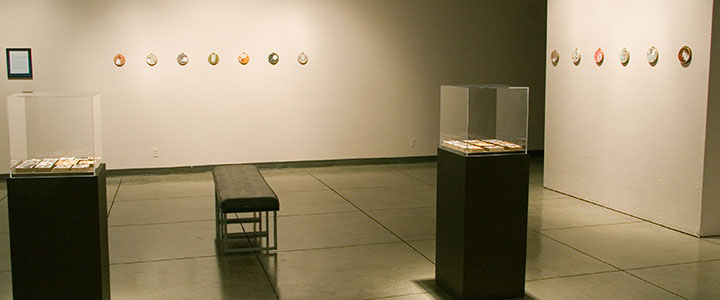
I was nervous about the possible absurdity of having twenty-six small pieces in a colossally huge space, but somehow, it works. Heather ingeniously used lighting and visual breaks to transform the gallery into a space that draws the viewer in and creates an intimate experience—which is exactly what I hoped for. Heather, I owe you big.
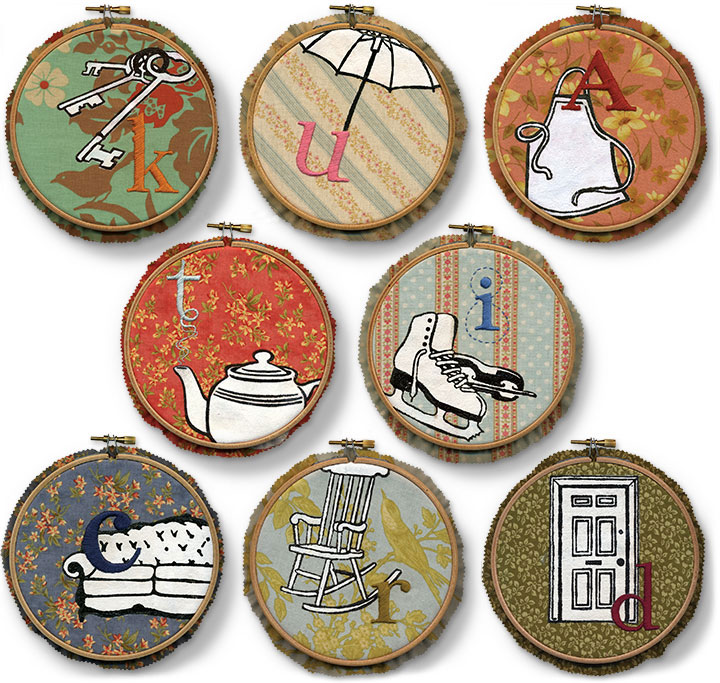
On to the work itself. Here is the artist statement for the exhibit:
The alphabet is one of the first lessons we learn as children. From the beginning we learn to use it as a mnemonic device—just like “Roy G. Biv,” or “Every Good Boy Deserves Fudge”—assigning meaning to our world by associating symbols with each letter. Because the alphabet is one of our most basic and effective memory tools, we are drawn to it as both a visual and narrative archetype. It’s not surprising, then, that the abecedary is somewhat of a staple among book artists.
Just as we use our ABCs as a memory aid, our possessions help us create the concept of Home. No matter what our economic station, living situation, or domestic permanence, we all tend to share similar symbols of comfort and nostalgia. These ideals are embodied in the everyday objects around us—those mundane materials we take for granted, yet without which we would sense something lacking. As someone who has never had a picket fence, who grew up in a nomadic military family, and who has lived her entire life with relatively few possessions, the archetypal Home should seem foreign to me. Yet the same mnemonic triggers exist in my mind; the same objects attract me.
Mnemonic Sampler collects and files our household icons, gathered together like the stitched and quilted samplers of our mothers and grandmothers. The hand-stitched alphabet enumerates my, your, our trappings, shuffling our collective domestic inventory like the old card game of Memory. Each symbol is familiar; each object is Ours, whether we actually possess it or not. Together they sketch out a Home—real or imagined; longed-for or spurned; past, present, or future.
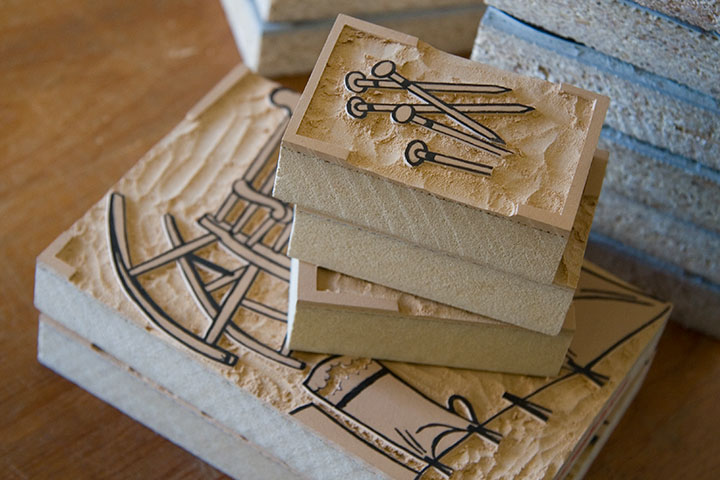
Mnemonic Sampler is a collection of monoprints, which means that instead of an edition of multiples, each print is created in such a way that it can’t exactly be reproduced. This technique results in a one-of-a-kind, totally unique piece—and is often more closely related to painting than printmaking. These pieces are printed from reduction-cut linoleum blocks—meaning both print colors are carved from the same block.
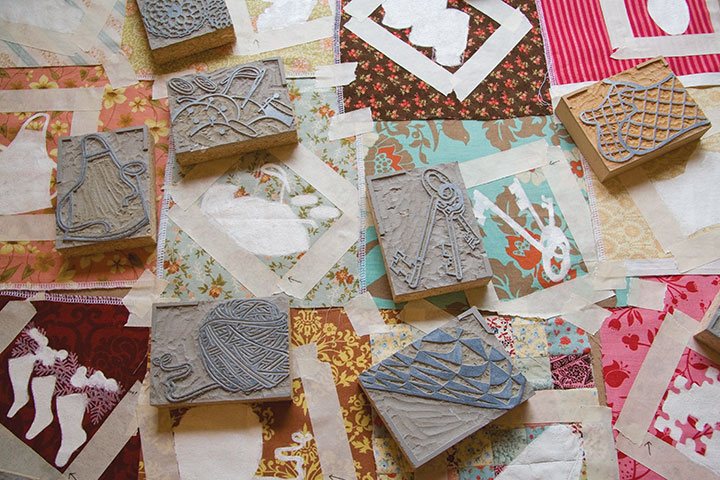
So once the second design is carved, the first color cannot be printed again.
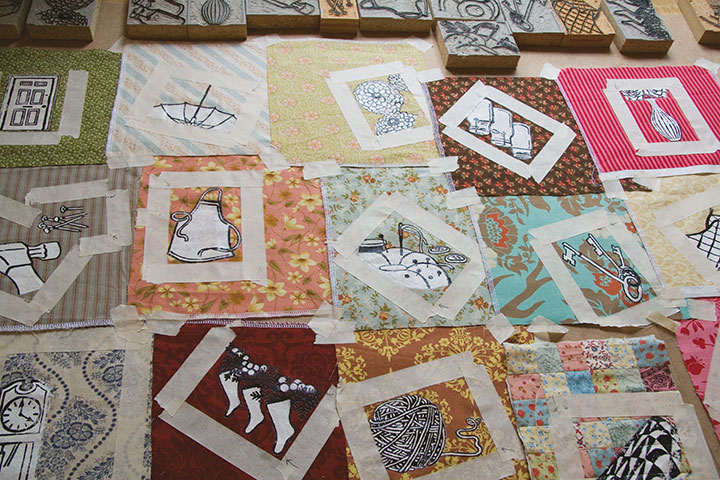
Designing these pieces was an intuitive process, consisting of both logical and intangible choices of fabric and pattern compositions. Because the design stage was so fluid (almost semi-conscious at times), it really wasn’t possible to do the printing on a press. Instead, each impression was made literally by hand, using masking tape to aid in color registration.
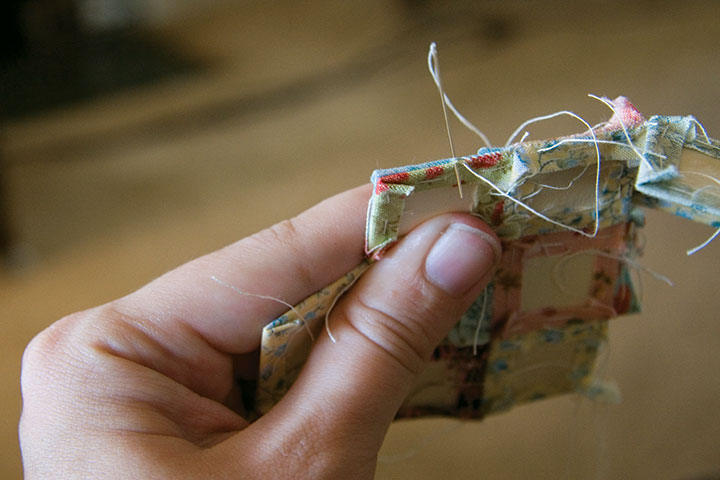
“Q” has an extra conceptual level, since the fabric background is a patchwork “quilt” in its own right. Like everything else about the series, the patchwork is sewn by hand, using the English paper piecing technique.
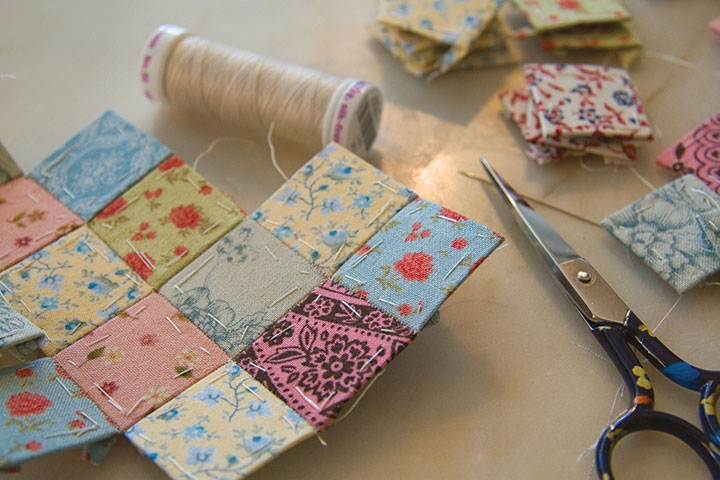
This was my first attempt at paper piecing, and I’m pleasantly surprised at how quick and accurate it is. Instead of folding and ironing every tiny piece, then wrangling a sewing machine, each patch is wrapped around a paper template and basted down, then whip-stitched together into a block.
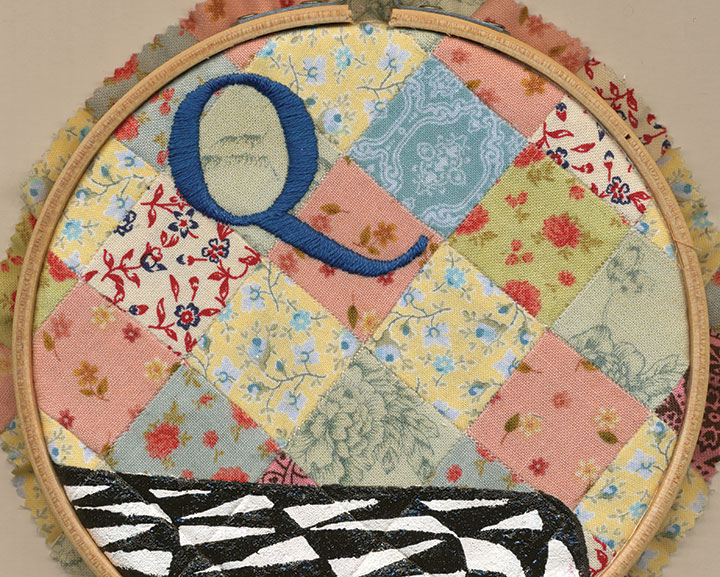
The result is a precise little quilt—perfect for embroidery.
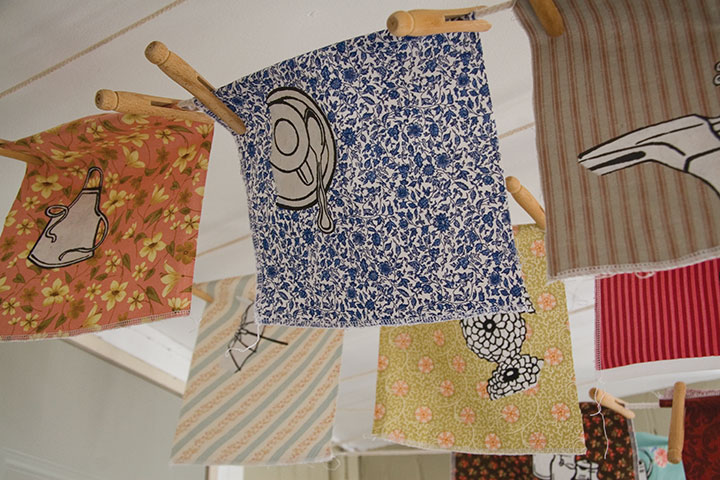
I can’t believe how long it took to complete every step of the process—and yet how quickly everything came together at the end. So you can bet I’m excited about celebrating at the opening tonight. And besides, I’m interested to see if the household objects I chose will resonate with viewers; it wasn’t easy to narrow things down to twenty-six letters of the alphabet, so I picked those objects that had the most meaning for me.
So how about it—what spells “Home” for you?
October 11th, 2009
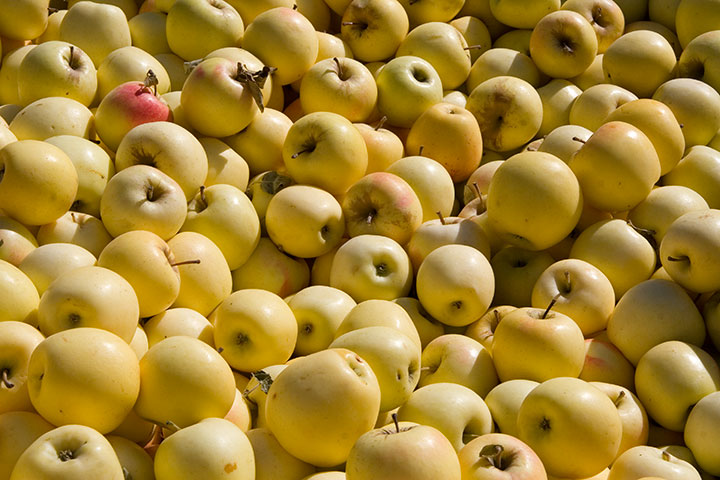
Autumn is, hands-down, my favorite time of year. So many of the things I love about fall have to do with food (mulled cider, pumpkin pie, spiced apples, butternut squash, fried green tomatoes, celeriac—the list goes on and on), and since the Tailor and I eat as seasonally and locally as we can, it’s a darn good thing we live in a state with such abundant produce at hand.
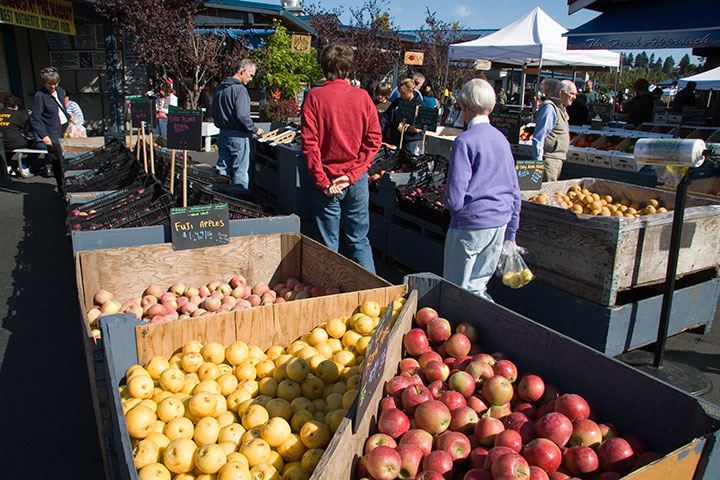
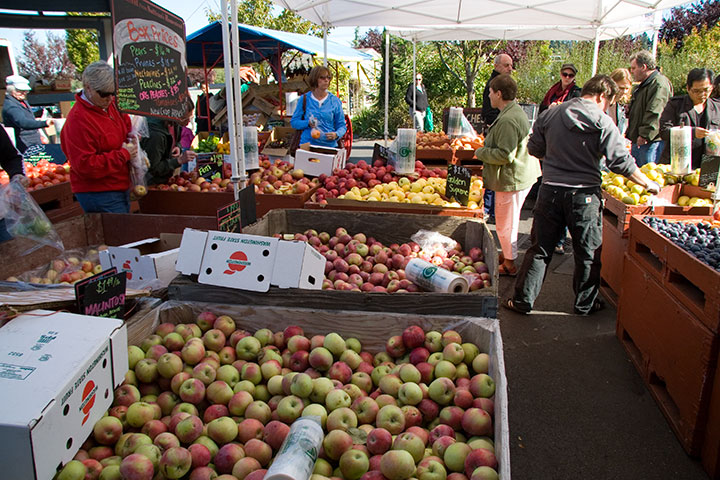
Both T-town and Seattle have incredible open-air markets (hello, Pike Place? I love you.), but my favorite of all is the quietly-unassuming Olympia Farmers Market. Our state capital might not be the hoppin’ tourist hub that downtown Seattle is, but Olympia’s gigantic, spectacular market is one of the best I’ve ever seen, anywhere.
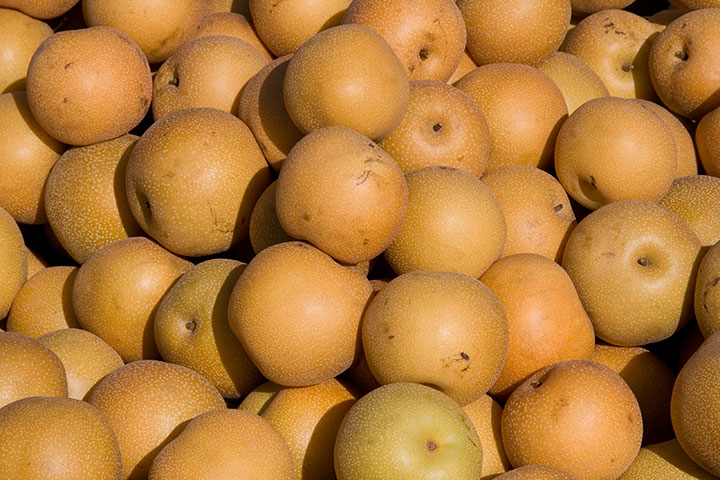
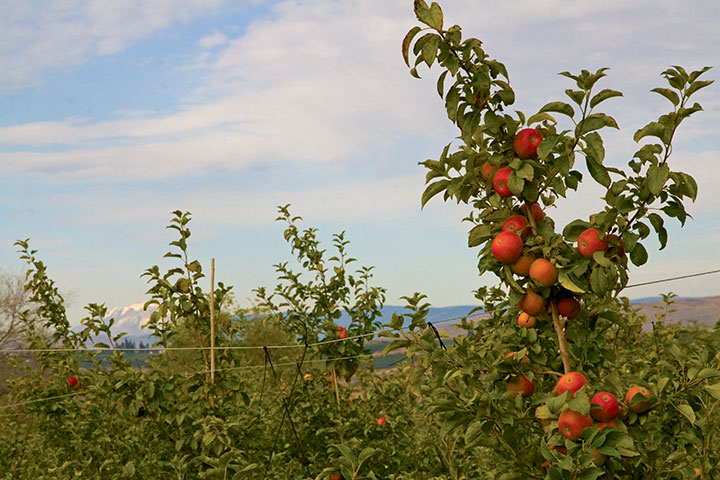
This is the place where you can find around forty different types of Washington apples, and another dozen or so kinds of pears (above are Asian pears, which count as honorary apples in my book).
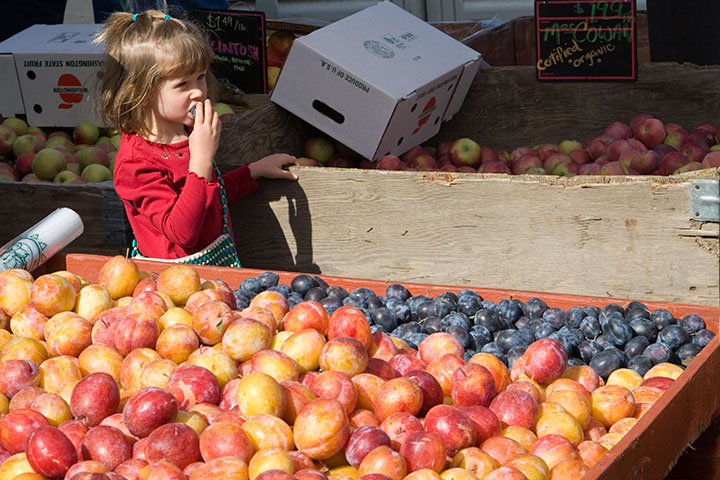
And there’s plenty of everything else, too. The sheer variety is staggering, and distracting—especially when your mission for the day is to buy just one variety of overwintering apples for your root cellar.
Though I must say, I love seeing the transformation from this:
To this:
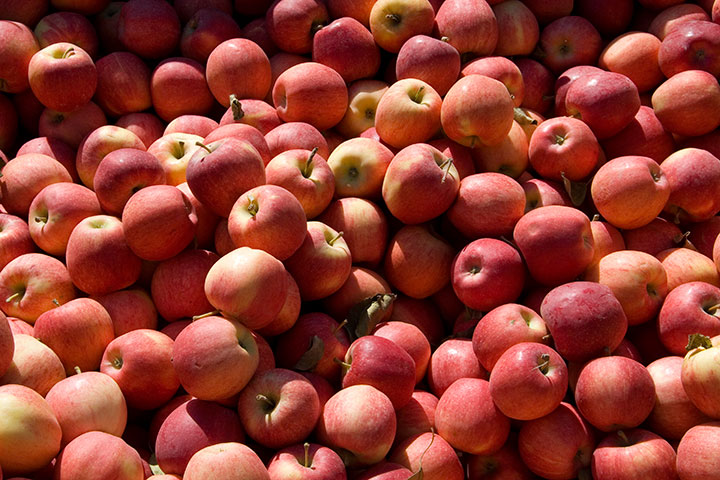
Ingredients for a perfect Sunday: crisp sunny weather, countless apple bins to dig through, a handful of friendly Olympians, and a dash of live bluegrass music for spice.
The apples are always a show-stopper, but our biggest goal for the day was something we can’t get at any of the three Tacoma farmers markets:
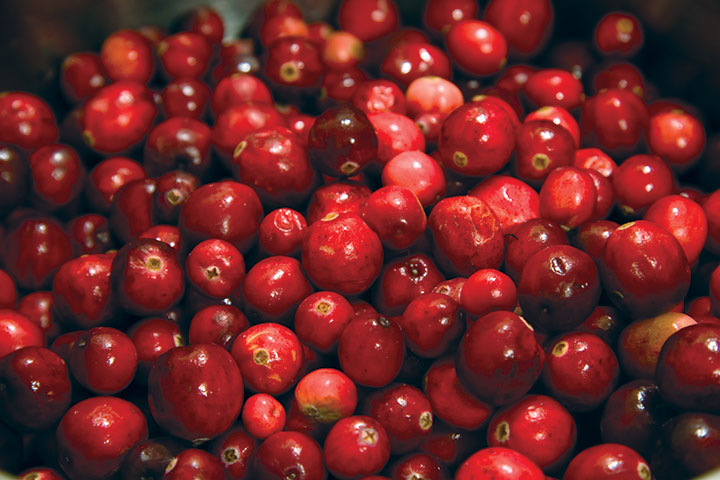
Fresh cranberries. Olympia is the first stop for cranberries coming in from the coast, and the season is now in full swing. We took home just five pounds this time, but you can bet we’ll be back for more. The Tailor and I have a deep and abiding love for cranberry sauce (it’s great on grits. Don’t look at me like that.), and we kicked off this year’s harvest by finishing off the last jar of our 2008 canning crop.
Homemade cranberry sauce is an incredibly easy thing—so much so that I really don’t understand why so many recipes call for Jello. Cranberries have so much natural pectin in them that with enough sugar they’ll jell on their own. In any event, the Tailor and I believe that cranberry sauce should be a sauce, not a can-shaped cylinder of jelly. So in honor of those little rubies from our rugged coast, here is our favorite recipe:
Cranberry sauce
– 1 lb. fresh cranberries, washed and drained
– 2 c. water
– 1 1/2 c. sugar
Combine the water and sugar and bring to a boil in a small saucepan. Boil for about two minutes on high before stirring in the cranberries. Put the lid on and listen; when the cranberries start popping like crazy and the sauce has begun to foam up, it’s done. This takes less than five minutes. Serve hot or cold (or on grits!).
Note: remember to put that lid on, or you’ll have hot, popping cranberries everywhere!
October 8th, 2009

All this outdoor research over the past few months has gotten me into the habit of carrying the camera everywhere, just in case the weather changes. I was on my way back from dropping my work off at the PLU Gallery when the fog rolled in. By the time I arrived at the waterfront, it was already passing, but I managed to capture this shot before the moment disappeared.
This place is so easy to love.
October 2nd, 2009
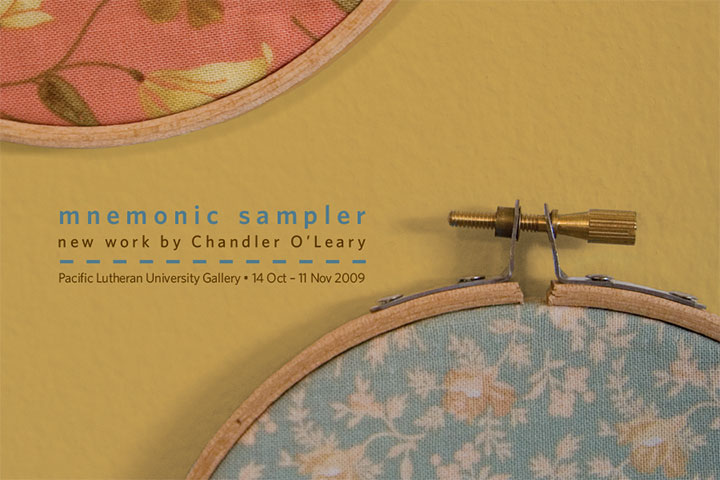
Finally, something tangible to show you! This is the point where all of the elements for my new body of work are just starting to come together. The past couple of months have been somewhat of a nail-biter—sometimes I wonder what possessed me to create twenty-six new pieces for a last-minute show. Now that the promo postcards (see above) are in hand and I can see the finish line, however, I can tell that my instincts knew what they were doing.
Mnemonic Sampler is my new solo show, opening October 14 at the PLU University Gallery. Here are the details:
Mnemonic Sampler: An Abecedary by Chandler O’Leary
October 14 to November 11
University Gallery, Ingram Hall
Pacific Lutheran University, Tacoma, WA
Opening Reception: Wednesday, October 14, 5-7 pm
On display will be something of a room-sized artist book, consisting of twenty-six hand-embroidered monoprints on calico (a monoprint is the opposite of an edition, a one-of-a-kind piece). Together the prints form an abecedary, or alphabet, and tell the story of how our concepts and ideals of “Home” are linked to the everyday objects that surround us. More on this topic when the show opens, but for now, here’s a peek (since the work is not quite finished, a peek is all I’ve got for now):
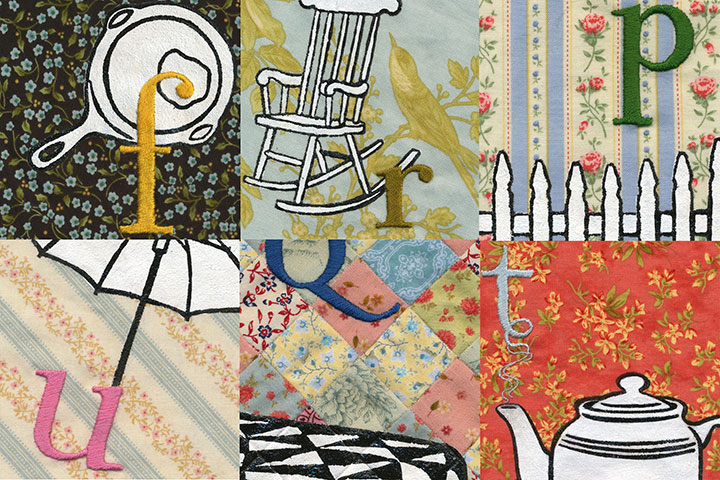
Many, many thanks to the talented and infinitely helpful Katie S. at PLU, who took care of having show postcards printed and mailed (!), orchestrated every logistic detail, and who has made the whole process as smooth as pumpkin pie. I would have long since lost my mind if it weren’t for you, Katie!

Speaking of amazing women who run galleries, another big thank-you and shout-out to Laura Russell of 23 Sandy Gallery in Portland, for featuring End of the Line on the promo materials for another new show that opens tonight. Broadsided! is national, juried exhibition of letterpress broadsides featuring the work of thirty-four artists. Here are the details from the 23 Sandy website:
Broadsided! The Intersection of Art and Literature
October 2-31, 2009
23 Sandy Gallery
623 NE 23rd Avenue
Portland, OR 97232
Opening reception: Friday, October 2, 6-9 pm
Before books, before blogs and before broadcasts, there were broadsides. Historically, single sheet broadsheet posters were ephemeral in nature. They were developed in the fifteenth century for royal proclamations, official notices and even advertisements. Today, broadsides hang at the intersection of art and literature. Letterpress printed broadsides are valued as fine art designed and printed by a true craftsperson; but also as fine literature featuring stellar poetry or prose.
The best part about the Broadsided! exhibit is that you don’t have to be local to see it! Laura has set up a fantastic online catalogue of the work in the show, with photos and the complete text from each broadside. Nothing beats seeing art in person, of course, but if you can’t make it to Portland this fall, this is a brilliant alternative.
![Chandler O'Leary [logo]](https://chandleroleary.com/wp-content/themes/chandleroleary/images/logo.png)